Who Pays What? Commercial Lease Types and Cap Rates (Real Estate Explained #7)
Who pays the bills on a commercial lease, and why does that change the cap rate? In this episode of Real Estate Explained, we walk through gross, modified gross, double net, triple net, and absolute net leases, what’s typical in apartments and in Class A, B, and C office, retail, and industrial, and how risk shows up on a cap-rate scale.
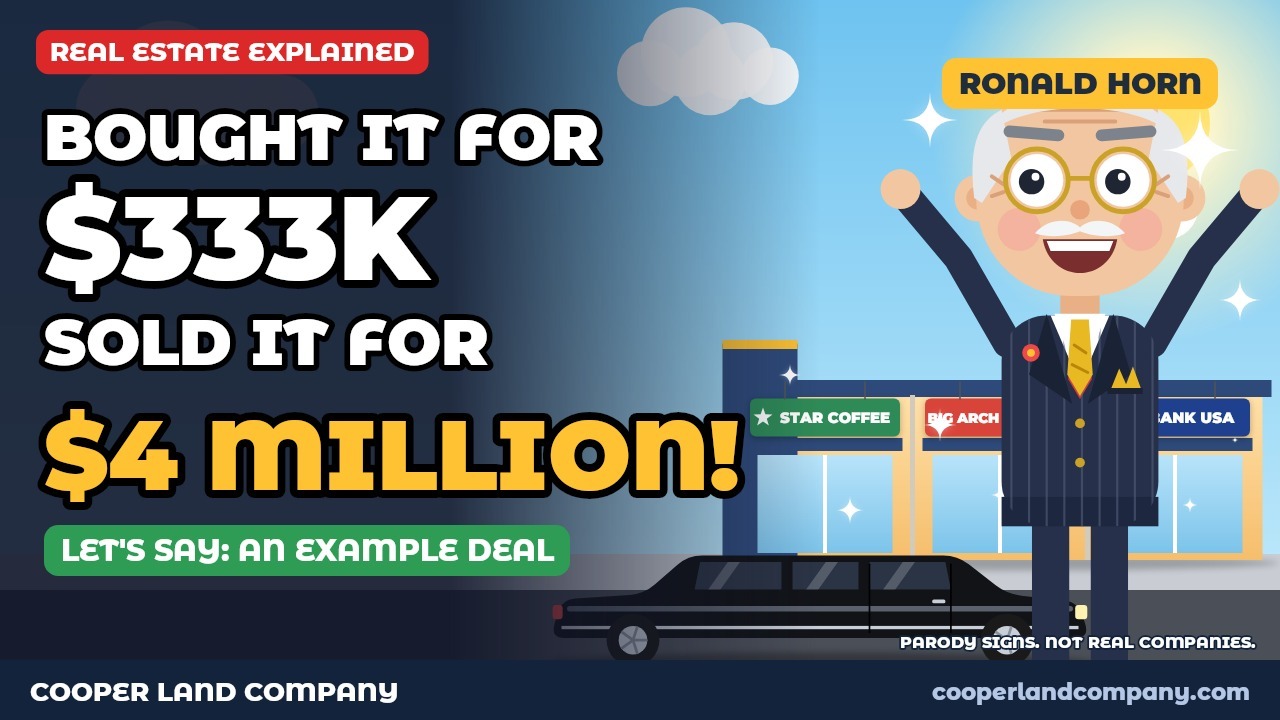
Then meet Ronald Horn, a value-add investor. Let’s say he buys a tired building earning only $40,000 a year, at a 12% cap, for about $333,000. He spends $800,000 to get it sparkling with tenant improvements, free rent, and commissions. New tenants move in, the income goes to $200,000 a year, and he sells the building at a 5% cap for $4 million. That’s a profit of about $2.9 million. Then he does a 1031 exchange and does it again.
Watch the related episodes:
- Watch the Ronald Horn Short
- Ep1 — Cap Rates
- Ep4 — How Do You Make Money in Commercial Real Estate?
- Ep5 — 1031 Exchanges Explained
- Ep2 — DSCR
- Ep3 — What Is Cost Segregation?
- Ep6 — What Is Depreciation Recapture?
- Full Real Estate Explained hub
Dan Cooper | Cooper Land Company | Licensed Texas Real Estate Broker #594068
Dan@CooperLandCompany.com
cooperlandcompany.com
Education only. Not legal, tax, or appraisal advice. Hank, Jake, and Ronald Horn are hypothetical. The dollar figures are a “let’s say” example, not a live market quote or a real listing. Lease terms vary; the lease controls. Confirm any plan with your own CPA, attorney, or broker.
Information About Brokerage Services: https://www.trec.texas.gov/forms/information-about-brokerage-services
Consumer Protection Notice: https://www.trec.texas.gov/forms/consumer-protection-notice
OUR LISTINGS

© 2026 Cooper Land Company
DMCA Notice | Terms & Services | Privacy Policy | Accessibility Statement
EQUAL HOUSING OPPORTUNITY



Cooper Land Company
2501 Greenspoint Ln, Prosper, TX 75078
Mobile: 214-714-5638
dan@cooperlandcompany.com