Bonus Depreciation
The 2026 Bonus Depreciation Guide: How to Zero Out Your Tax Bill with the "One Big Beautiful Bill"
![[HERO] The 2026 Bonus Depreciation Guide: How to Zero Out Your Tax Bill with the "One Big Beautiful Bill"](https://cdn.marblism.com/v6um2eZNM9r.webp)
If you've been sitting on the fence about pulling the trigger on a commercial property or exploring Texas land for sale, the One Big Beautiful Bill Act (OBBBA) just handed you a legitimate cheat code. Passed in July 2025, this legislation permanently restored 100% bonus depreciation for qualified property placed in service after January 19, 2025: and if you know how to structure the deal correctly, you can essentially write off the entire purchase price in Year One.
Let's break down exactly how this works, which properties qualify, and why certain asset classes in North Texas are absolute goldmines right now.
The 100% Comeback: What Changed Under OBBBA (Permanent 100%)
Here's the headline: Under OBBBA, for any qualified property you acquire and place in service after January 19, 2025, you can deduct 100% of the depreciable basis in the first year. Not 20%. Not 80%. The full amount.
Before OBBBA, bonus depreciation was scheduled to phase down. Now? It's permanently locked at 100% for qualifying assets placed in service after January 19, 2025, which means the timing on North Texas land for sale with development potential or income-producing properties just became incredibly attractive.
The IRS issued Notice 2026-11 on January 14, 2026, giving us interim guidance while the formal regulations get ironed out. Translation: You can start using this strategy on your 2026 return right now, because 2026 is inside the permanent 100% era (post-1/19/2025).
The Life Span Breakdown: Not All Property Is Created Equal
Understanding MACRS recovery periods is critical because only certain categories qualify for bonus depreciation. Here's the quick version:
5-Year Property: This is your personal property bucket: specialty lighting, carpeting, furniture, technology infrastructure, decorative fixtures. Think of it as anything that's not nailed down to the structure itself. In a typical commercial build-out, this can represent 15-25% of your total project cost.
15-Year Property: This covers land improvements like parking lots, fencing, landscaping, exterior signage, and driveways. But here's where it gets interesting: Retail Motor Fuel Outlets (gas stations) also fall into this category under specific conditions, which we'll cover in a second.
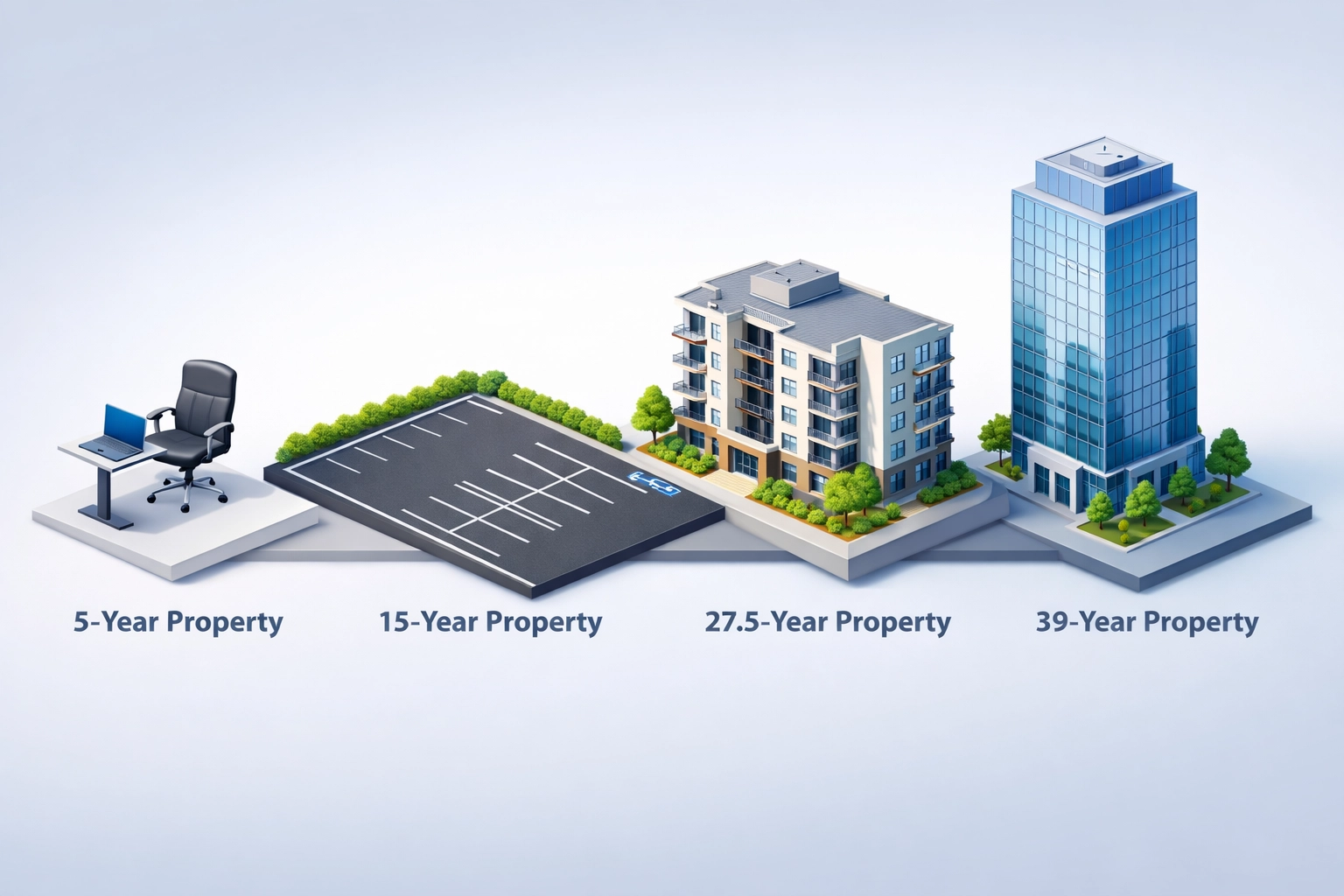
27.5-Year Property: Residential rental structures. The actual building itself if you're buying an apartment complex or single-family rental. The structure doesn't qualify for bonus depreciation, but everything inside it that you can reclassify does.
39-Year Property: Commercial real estate structures. Same deal: the building shell is on a 39-year schedule, but the components you pull out through cost segregation are fair game.
The strategy here isn't to write off the entire building. It's to surgically extract the 5-year and 15-year components and front-load those deductions into Year One.
The "Jackpot" Properties: Gas Stations, Car Washes, and Quick Lubes
This is where things get wild. Certain property types have IRS rules that allow you to classify the entire building structure as 15-year property instead of 39-year: which means the whole thing becomes eligible for 100% bonus depreciation.
Gas Stations (Retail Motor Fuel Outlets):
If the property meets the "50% Test," the building qualifies as 15-year property. The test is simple: Either 50% of the gross revenue comes from petroleum sales, or 50% of the floor space is dedicated to petroleum marketing activities. When this applies, you're not just expensing the pumps and canopy: you're expensing the entire convenience store structure in Year One.
Car Washes:
Under IRS guidelines, a car wash that meets the "1,400 sq ft rule" gets the same treatment. If the building is 1,400 square feet or less and primarily used for vehicle washing, it's classified as 15-year property. Tunnel washes, self-serve bays, and express exterior washes almost always qualify. Run the numbers on a $2.5M car wash facility in Prosper or Celina, and you're looking at a seven-figure deduction in Year One.
Oil Change Facilities (Quick Lubes):
Same concept. If the building is under 1,400 sq ft and used primarily for quick-service vehicle maintenance, it's 15-year property. The entire structure becomes bonus-eligible.
For investors looking at land acquisition services in North Texas with an eye toward development, these asset classes are essentially tax arbitrage plays. You're not just buying a business: you're buying a first-year write-off.
Cost Segregation: Unlocking Hidden Value in Standard Buildings
Let's say you're not buying a car wash. You're buying a standard retail strip center, an office building, or a residential fourplex. The building itself is still 27.5 or 39-year property, but a cost segregation study can reclassify 20-40% of the purchase price into shorter life categories.
Here's how it works:
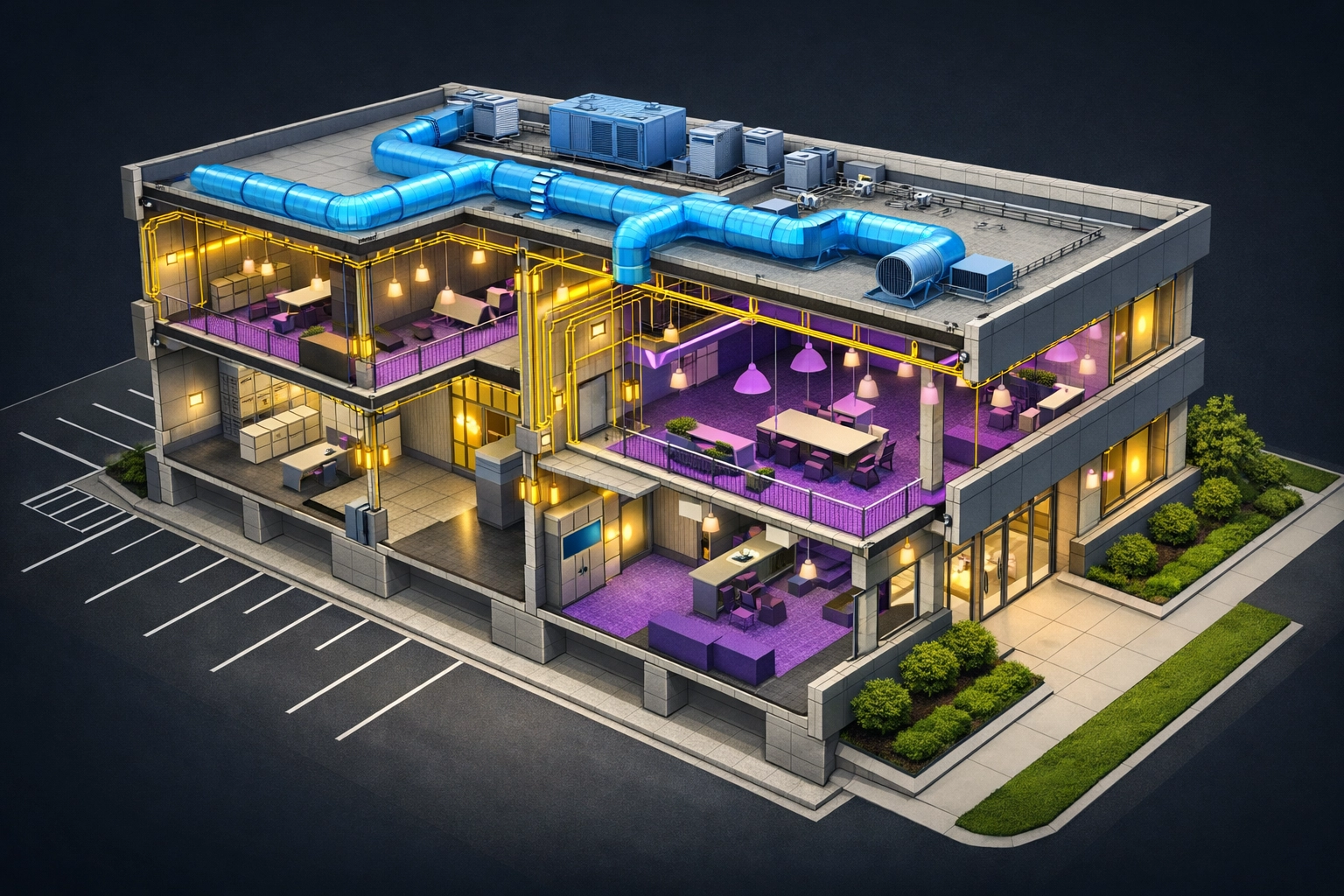
A cost segregation engineer walks through the property and breaks down every component. HVAC ductwork? Could be 5-year. Specialized electrical for tenant improvements? 5-year. Parking lot, sidewalks, and landscaping? 15-year. Decorative lighting, carpeting, and modular walls? 5-year.
Suddenly, a $3M office building in Frisco becomes a $2M structure (39-year) plus $600K in 5-year property (bonus eligible) and $400K in 15-year property (bonus eligible). You just created a $1M first-year deduction on a property that would have otherwise depreciated slowly over four decades.
For anyone working with a land broker Texas on ground-up construction, this becomes even more powerful. You can engineer the cost segregation into the building design before the first shovel hits dirt.
Depreciation Recapture & The Opportunity Zone Escape Hatch
Now for the fine print: When you sell the property, the IRS wants its money back. This is called depreciation recapture, and it's taxed at 25%: higher than long-term capital gains.
If you took $1M in bonus depreciation in Year One and sell the property five years later, that $1M gets recaptured at 25% ($250K tax hit). It's still a net win because you got the time value of money, but it's not a free lunch.
Unless you're in an Opportunity Zone.
Qualified Opportunity Zones (QOZs) and Qualified Rural Opportunity Zones (QROZs) have a nuclear option: If you hold the investment for 10 years, your basis steps up to fair market value at the time of sale. That wipes out all depreciation recapture and capital gains tax. Zero.
For long-term holders buying land development Texas projects in OZ-designated areas like parts of Dallas, southern Collin County, or Denton County, this is the ultimate tax elimination strategy. You front-load the depreciation, hold for a decade, and exit tax-free.
Why This Matters in North Texas Right Now
Dallas, Collin, and Denton Counties are in the middle of one of the most aggressive commercial and residential expansion cycles in the country. The infrastructure build-out alone: new tollway extensions, corporate relocations, residential development: is creating a once-in-a-generation opportunity for strategic buyers.
When you combine 100% bonus depreciation with the growth trajectory we're seeing in Prosper, Celina, and Gunter, the math gets ridiculous. You're not just banking on appreciation. You're also creating immediate tax offsets that can shelter income from other sources.
If you're looking at commercial property, income-producing land, or development sites, the key is that qualified property placed in service after January 19, 2025 is in the permanent 100% bonus depreciation era under OBBBA, and 2026 falls squarely inside that period.
At Cooper Land Company, we're working with investors and developers who are structuring acquisitions specifically around these bonus depreciation windows. Whether it's identifying Texas land for sale with OZ benefits, sourcing car wash sites, or running the numbers on retail fuel conversions, the opportunities are stacking up.
If you want to talk strategy on how this applies to your specific situation: or if you're ready to explore what's available in North Texas right now: let's connect. This window won't last forever, and the properties that pencil out under these rules are moving fast.
OUR LISTINGS

© 2026 Cooper Land Company
DMCA Notice | Terms & Services | Privacy Policy | Accessibility Statement
EQUAL HOUSING OPPORTUNITY



Cooper Land Company
2501 Greenspoint Ln, Prosper, TX 75078
Mobile: 214-714-5638
dan@cooperlandcompany.com