The Gunter Gap
The Gunter Gap: Why the Space Between Frisco and Sherman is Closing Fast
![[HERO] The Gunter Gap: Why the Space Between Frisco and Sherman is Closing Fast](https://cdn.marblism.com/WY57FQ2CjpZ.webp)
It's not just a drive between cities anymore. The 30-mile stretch of Highway 289 connecting Frisco and Sherman used to be something you'd power through on your way to Lake Texoma. Now? It's the next multi-billion dollar corridor: and the land caught in the middle is some of the most sought-after dirt in the country.
If you've been watching North Texas development over the last decade, you've seen Frisco expand north like it has somewhere to be. And if you've been paying attention to Grayson County, you know Sherman isn't sitting still either. What's happening now is what I call the "sandwich effect": two powerhouse markets squeezing the space between them until that space becomes the main event.
Let's talk about why Gunter and Van Alstyne are about to have their moment.
Frisco's Northern Push: The Unstoppable Machine
Frisco doesn't do anything halfway. The city has been the poster child for explosive growth in Texas for two decades, and it's showing zero signs of slowing down. But here's the thing: Frisco is running out of Frisco.
The city has annexed, developed, and built out nearly every available acre within its ETJ (extraterritorial jurisdiction). So where does all that momentum go? North. Straight up Highway 289.

The evidence is everywhere. PGA Parkway: the key north-south artery connecting Frisco to points beyond: is being widened from four lanes to six lanes, with completion slated for May 2026. That's not a traffic mitigation project. That's infrastructure preparing for the inevitable wave of rooftops, retail, and commercial development heading north.
When a city spends that kind of money on road capacity, it's a signal. Developers, investors, and landowners know what it means: this corridor is about to explode.
Sherman's Industrial Boom: The Silent Giant
While everyone's been obsessing over Frisco's northern sprawl, Sherman has quietly become one of the most important industrial hubs in the region. And I'm not talking about small-time warehouse operations.
Texas Instruments has been a mainstay in Sherman for decades, but the recent surge in semiconductor demand has turned the facility into a strategic national asset. Add to that GlobiTech's massive footprint in the area, and you've got a city that's not just growing: it's anchoring a new chapter of North Texas economic dominance.
Here's what that means for land: jobs follow industry, housing follows jobs, and retail follows housing. Sherman's industrial boom creates a ripple effect that doesn't stop at the city limits. It radiates south, right into the heart of Grayson County.
And guess what sits directly in that path? Gunter and Van Alstyne.
The Sandwich Effect: Where the Real Money Is
When two high-growth markets push toward each other, the land in between doesn't stay cheap for long. This is Economic Geography 101, but it plays out in real time with brutal efficiency.
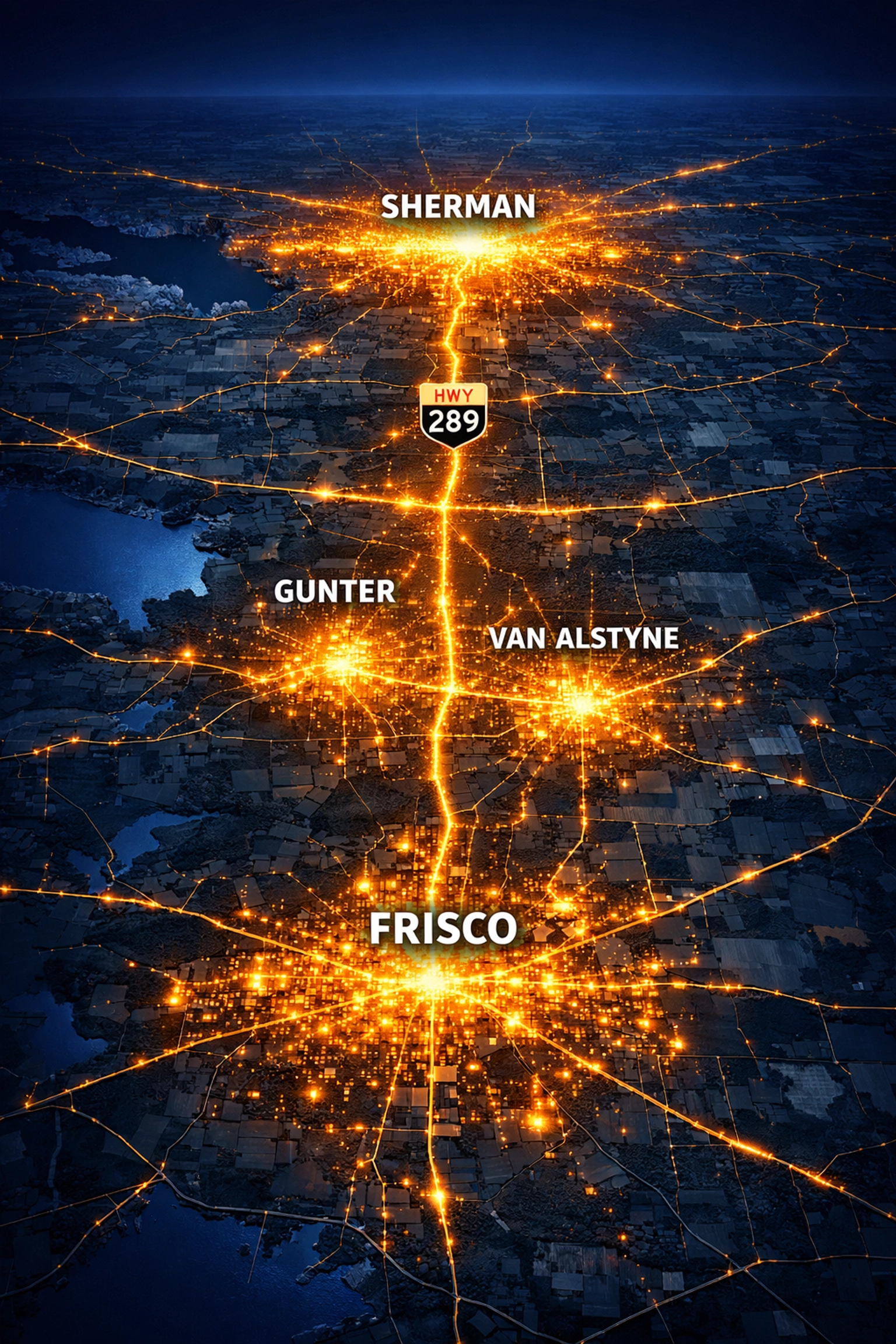
Frisco's northern expansion is driven by residential and mixed-use demand. Families want land, they want good schools, and they want to be close enough to the amenities and infrastructure that Frisco offers without paying Frisco prices.
Sherman's pull is employment-driven. Workers at TI and GlobiTech need places to live. They want short commutes. They want affordable housing stock. And they don't want to sit in traffic for 45 minutes each way.
The result? Gunter and Van Alstyne become the logical middle ground. They're close enough to Frisco to benefit from its infrastructure and development expertise. They're close enough to Sherman to capture the industrial workforce demand. And they're far enough from both to still offer land at a discount: for now.
This is the sandwich effect. And if you've studied land cycles in North Texas, you know what happens next: prices compress, demand surges, and the "middle" becomes the hottest market in the region.
Why Gunter and Van Alstyne Are the Sweet Spot
Let's get specific. Gunter sits at the intersection of Highway 289 and FM 121: two key arteries connecting the region. It's a small town with big access. Van Alstyne, just to the east, sits along U.S. 75, one of the most heavily trafficked north-south corridors in Texas.
Both towns have maintained their small-town character while sitting on top of some of the most strategic dirt in the state. They've got water access, utility infrastructure on the horizon, and school districts that are already planning for growth.
Here's what makes them special:
Proximity to Frisco's Growth Machine: Gunter is less than 20 miles from Frisco's northern edge. That's not a long commute. That's a same-county address. As Frisco pushes north, Gunter is the first stop on the express train.
Access to Sherman's Employment Base: With Sherman's industrial sector firing on all cylinders, workers need housing. Gunter and Van Alstyne offer affordable alternatives to Sherman's increasingly tight housing market: and they're closer to the highway.
Infrastructure Investment: The PGA Parkway expansion isn't the only project in the pipeline. Utility districts are forming. Water and sewer lines are being planned. These aren't speculative projects: they're response mechanisms to real demand.
Land Supply: Unlike Frisco, which is nearly built out, Gunter and Van Alstyne still have large tracts of available land. That means developers can assemble meaningful parcels for residential subdivisions, commercial nodes, and mixed-use projects.
The Six-Lane Signal: PGA Parkway and What It Means
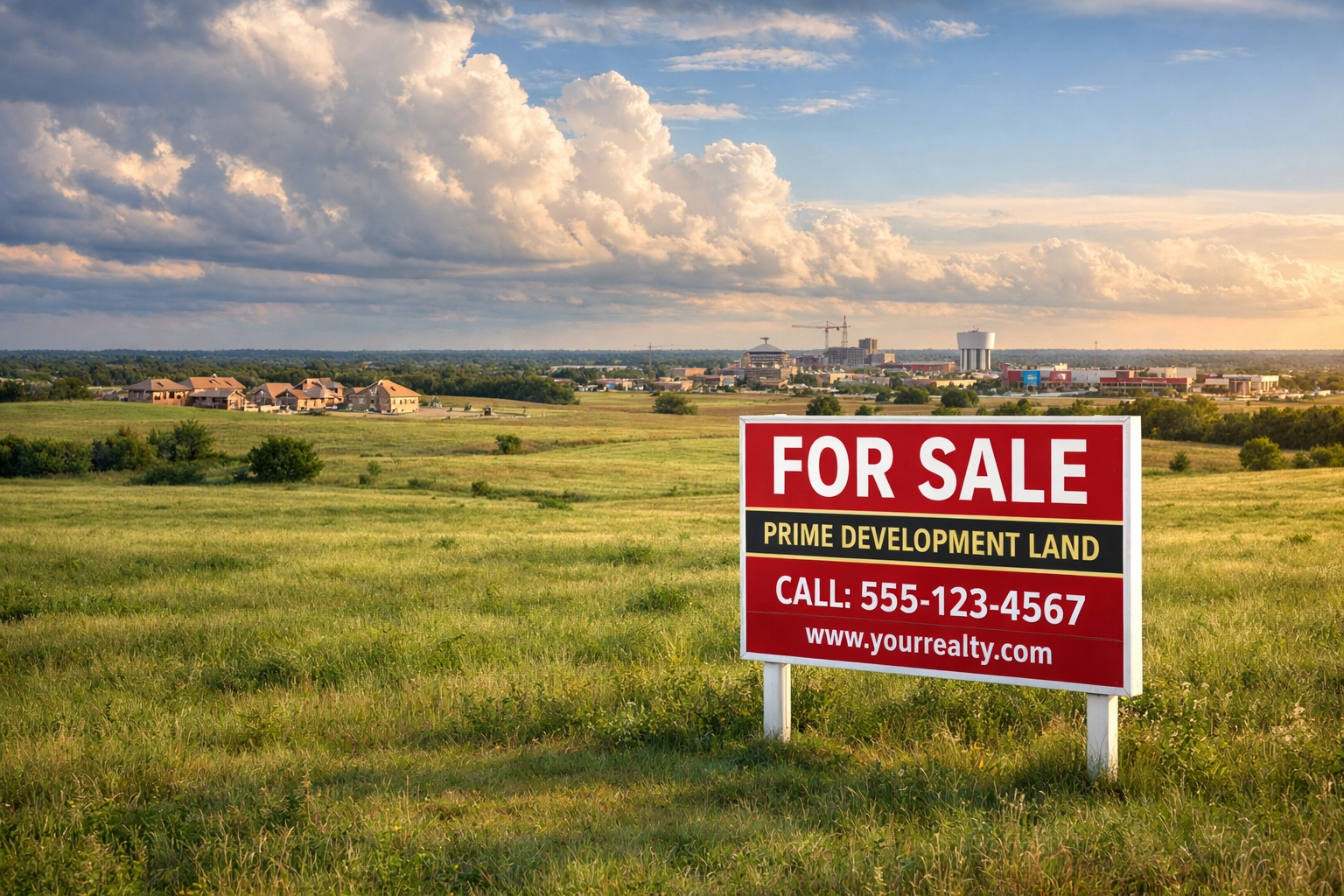
Let's circle back to that PGA Parkway expansion, because it's not just a construction project: it's a declaration of intent.
When a major thoroughfare gets widened to six lanes, you're looking at a minimum 20-year planning horizon. Traffic engineers don't add capacity unless they're certain it's going to be used. That means the models are already showing the population surge. The development applications are already in the pipeline. The growth is baked in.
The May 2026 completion date is significant. That's less than four months away. Once that road opens up with full capacity, the commute from Gunter to Frisco becomes seamless. Travel time drops. Perceived distance shrinks. And suddenly, living in Gunter while working in Frisco or Plano becomes not just viable: it becomes attractive.
For land investors, the play is clear: get in before the road opens. Once that six-lane highway is operational, prices will adjust to reflect the new reality.
What This Means for Investors and Developers
If you're holding raw land in the Gunter Gap, you're sitting on a generational opportunity. If you're a developer looking for the next high-yield project, this corridor should be at the top of your target list.
Here's the playbook:
Identify Pre-Infrastructure Plays: Land that's close to future utility expansion or sewer line extensions is gold. Buy before the pipes arrive, and you'll watch your basis multiply as soon as the infrastructure is announced.
Target Commuter-Friendly Tracts: Properties with direct access to 289 or FM 121 will command premium prices. Accessibility is everything in this market.
Think Mixed-Use: The old model of "subdivide and sell" still works, but the real value creation is in master-planned communities that blend residential, retail, and office. Gunter and Van Alstyne are perfect candidates for this approach.
Watch the School Districts: One of the biggest drivers of residential demand is school quality. Gunter ISD and Van Alstyne ISD are both well-regarded and positioned for growth. That's a key selling point for family-oriented buyers.
The Bottom Line
The Gunter Gap isn't a gap anymore: it's a corridor. And corridors create wealth.
Frisco's relentless northern expansion and Sherman's industrial dominance are creating a compression zone that's going to redefine North Texas real estate over the next decade. The land in between: specifically around Gunter and Van Alstyne: is transitioning from "rural" to "strategic" in real time.
The infrastructure is coming. The jobs are already here. The demand is building. And the window to get in at pre-growth pricing is closing fast.
If you've been waiting for the next Prosper, the next Celina, or the next Little Elm, stop waiting. You're looking at it. It's just 30 miles north of where you thought it would be.
OUR LISTINGS

© 2026 Cooper Land Company
DMCA Notice | Terms & Services | Privacy Policy | Accessibility Statement
EQUAL HOUSING OPPORTUNITY



Cooper Land Company
2501 Greenspoint Ln, Prosper, TX 75078
Mobile: 214-714-5638
dan@cooperlandcompany.com