Section 179 for Developers: The Infrastructure Deduction You Might Be Missing
![[HERO] Section 179 for Developers: The Infrastructure Deduction You Might Be Missing](https://cdn.marblism.com/NP2CiOTztey.webp)
Most developers know about the F-150 deduction. Section 179 has become famous for letting business owners write off trucks and equipment in the year they buy them. But if that's where your knowledge of Section 179 stops, you're leaving money on the table: especially in 2026 when you're trying to offset the cost of getting a raw tract "pad ready."
Section 179 isn't just for vehicles. It's a powerful tool for immediately deducting infrastructure equipment, technology systems, and certain building improvements that go into transforming dirt into developable land. And when you're carrying high-interest debt on a land hold, every dollar you can keep in the bank matters.
Let's break down how this deduction actually works for developers and why it's worth a serious conversation with your CPA before year-end.
What Section 179 Actually Does
Section 179 allows eligible businesses to immediately deduct the full purchase price of qualifying equipment and software in the year it's acquired, rather than depreciating those assets over multiple years. It's the difference between writing off a $100,000 piece of equipment all at once versus spreading that deduction over five or seven years.
For 2026, the deduction limit is $2,560,000. That's the total amount you can write off across all qualifying purchases in a single tax year. For most land developers working on one or two projects at a time, that ceiling is more than enough to cover the infrastructure investments you're making.
The beauty of Section 179 is timing. If you're moving dirt in Q4 of 2026 and you drop $200,000 on earthmoving equipment, you can deduct the full amount on your 2026 return. That immediate reduction in taxable income frees up capital you can use to keep the project moving: or to grab the next deal that shows up.
What Actually Qualifies for Developers
Here's where it gets interesting for land guys. Section 179 isn't limited to pickup trucks and excavators. The list of qualifying assets includes:
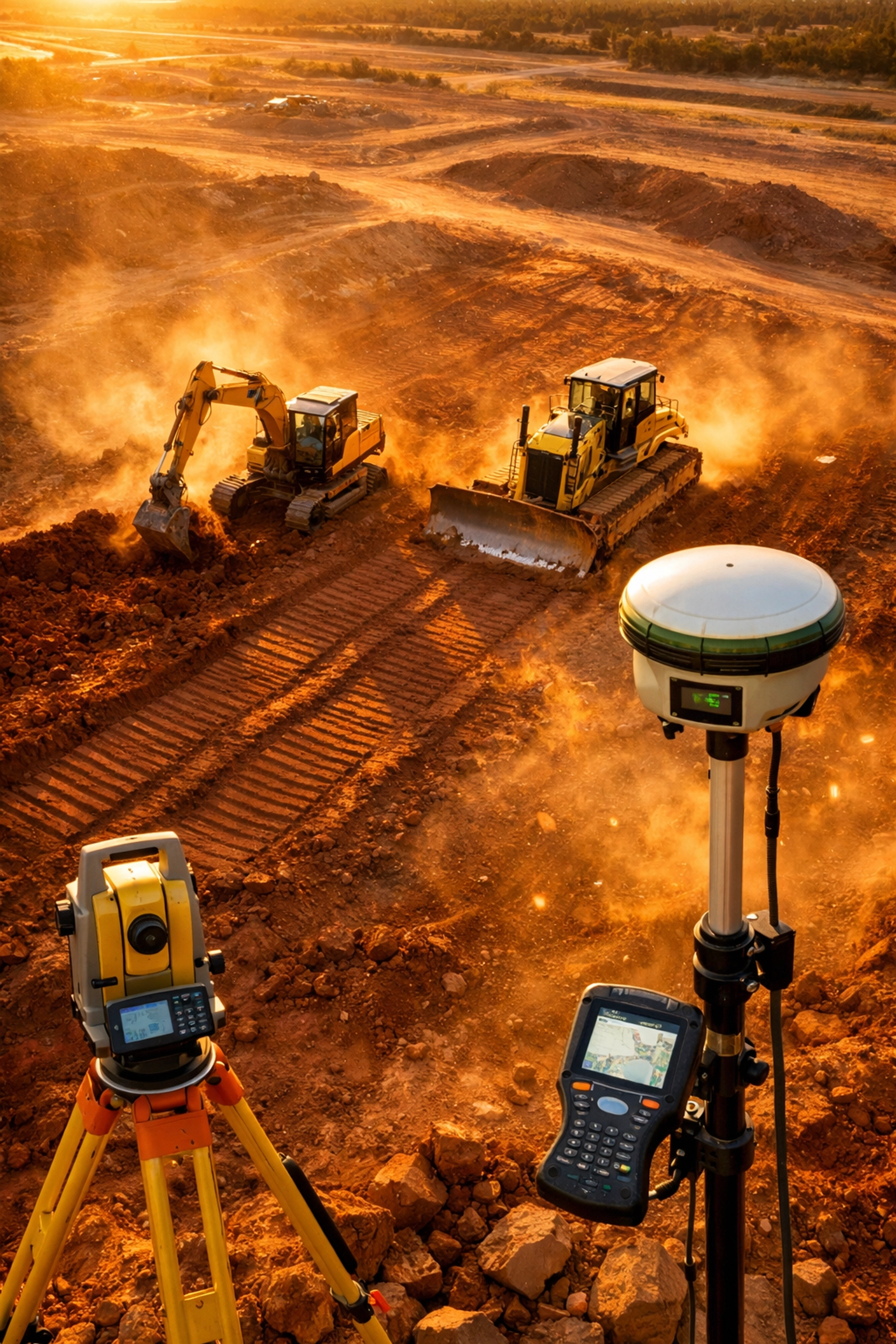
- Computers and technology systems – If you're running project management software, GPS grading systems, or even just upgrading the office setup, it counts.
- Off-the-shelf software – CAD programs, estimating tools, and accounting platforms all qualify.
- Office furniture and equipment – Desks, conference tables, filing systems: anything you need to run the business side of development.
- Manufacturing and production equipment – For developers doing any kind of on-site fabrication or material prep, this is a big one.
- Certain building improvements – This is the sleeper category. Roofs, HVAC systems, fire protection, alarm systems, and security systems installed in non-residential buildings can qualify under Section 179. If you're building out a model home sales office or a site trailer, some of those improvements may be deductible.
- Specialized non-passenger vehicles – This is the famous truck category, but it also covers heavy equipment like bulldozers, loaders, and dump trucks that aren't designed for highway use.
The key distinction is that the asset has to be used for business purposes more than 50% of the time. If you're buying a truck that doubles as your family SUV, you'll need to calculate the business-use percentage. But if it's a skid steer that never leaves the job site, you're in the clear.
Used Equipment Counts Too
One of the most underrated features of Section 179 is that it applies to used equipment: as long as it's "new to you." Bonus depreciation, which we've talked about in other posts, only works on brand-new assets. But Section 179 lets you deduct used graders, tractors, and even older software licenses if you're buying them for the first time.
This is huge for smaller developers who are bootstrapping projects and buying equipment at auction or from other contractors. You don't have to spring for the newest model to get the tax benefit. As long as the asset is in service and being used for your business, it qualifies.

The Strategy: Pairing Section 179 with Bonus Depreciation
Here's where the math gets fun. In 2026, bonus depreciation is back at 100% for qualifying property placed in service after January 19, 2025. That means certain assets can be fully expensed under bonus depreciation rules, while others might make more sense under Section 179.
Your CPA will help you decide which assets go where, but the general strategy is to maximize your deductions by stacking both tools. For example, you might use Section 179 for smaller purchases like office equipment and software, then apply 100% bonus depreciation to big-ticket items like a new excavator or a fleet of utility vehicles.
The combined benefit can be substantial: especially if you're also running a cost segregation study on any structures you're building. When you increase your upfront deductions through Section 179 and bonus depreciation, you're also increasing your unadjusted basis in assets, which can improve your eligibility for the qualified business income (QBI) deduction under Section 199A.
It's a layered approach, and it requires some planning. But the result is a significantly lower tax liability in the year you're making big investments, which means more cash on hand to keep the project moving.
Getting Sites "Pad Ready"
For land developers, the real value of Section 179 shows up when you're preparing a site for vertical construction. Getting raw land to "pad ready" status involves a lot of equipment purchases:
- Grading and earthmoving machinery
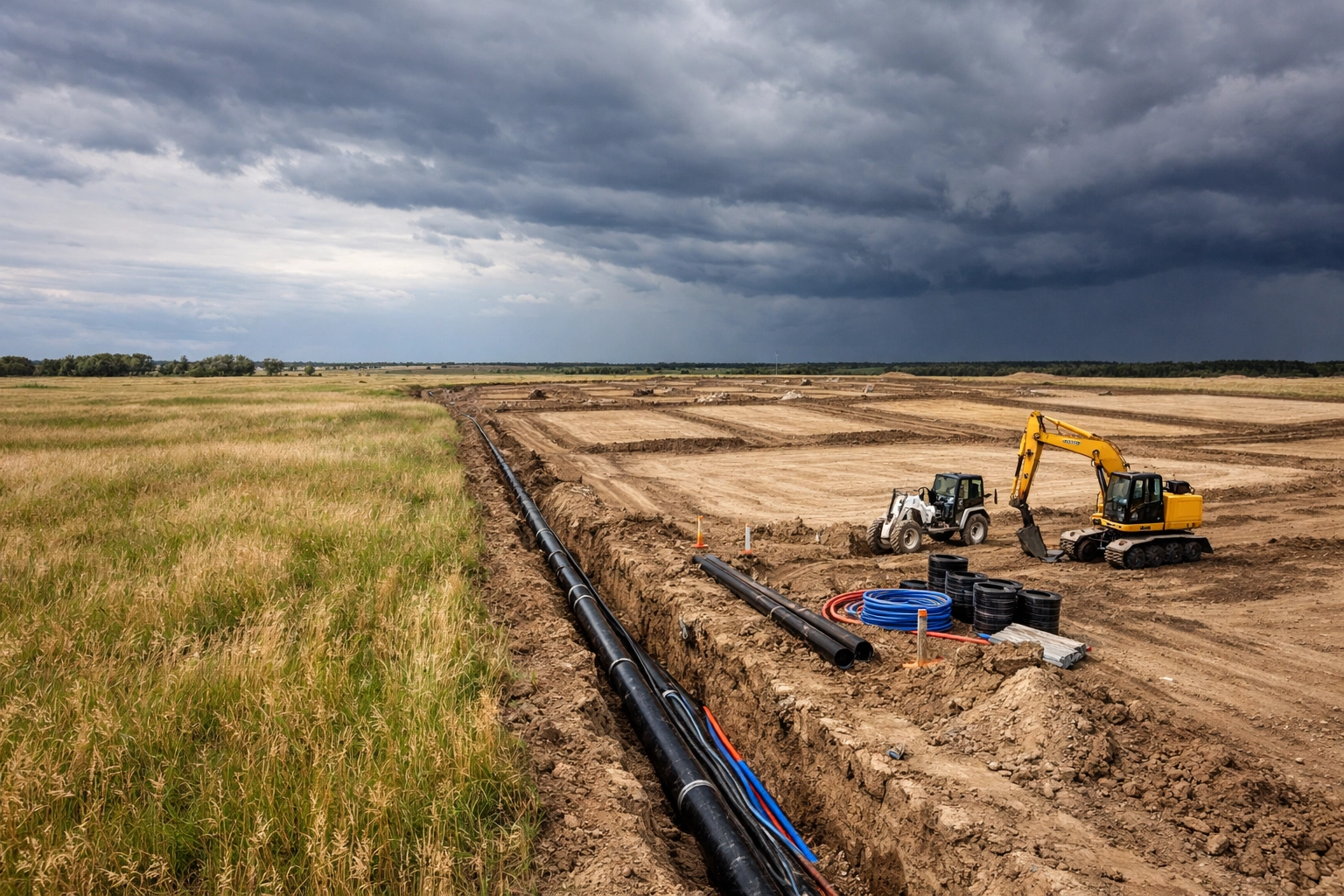
- Utility trenchers and boring equipment
- Temporary power and water infrastructure
- Site surveying and GPS technology
- Material handling equipment
All of those purchases are potentially deductible under Section 179, depending on how they're classified and used. The deduction doesn't apply to the land itself or to permanent structures like roads and drainage systems: but the equipment used to build those improvements? That's fair game.
Let's say you're prepping a 50-acre tract in Anna for a residential subdivision. You buy a used bulldozer for $80,000, a GPS grading system for $25,000, and a utility trencher for $40,000. That's $145,000 in immediate deductions under Section 179, assuming all three assets are placed in service before the end of the tax year.
If you're in a combined federal and state tax bracket of 35%, that $145,000 deduction saves you roughly $50,750 in taxes. You just reduced your carry cost on the project by that amount: and you still own the equipment.
Section 179D: A Different Beast
Before we wrap up, it's worth mentioning Section 179D, which is a completely separate tax incentive that often gets confused with Section 179. Section 179D is a deduction for architects, engineers, contractors, and designers who create energy-efficient commercial buildings for government or nonprofit entities.
If your firm is involved in designing or building public-sector projects: schools, municipal buildings, nonprofit facilities: Section 179D can be valuable. But there's a catch: the deduction is terminating for construction projects beginning after June 30, 2026. If you're working on any public-sector projects with energy-efficient components, now's the time to get those plans locked in before the deadline.
For most private land developers, Section 179D isn't relevant. But if you're doing design-build work for cities or school districts, it's worth a conversation with your tax advisor.
The Fine Print
Section 179 has a few limitations worth noting:
Income Limitation: You can't deduct more than your taxable business income. If your business shows a loss for the year, the Section 179 deduction gets carried forward to the next year. It doesn't disappear, but you also don't get the immediate benefit.
Phase-Out Threshold: If you purchase more than $3,200,000 in qualifying assets in a single year, the $2,560,000 deduction limit starts to phase out dollar-for-dollar. This rarely affects small to mid-sized developers, but it's something to be aware of if you're scaling up quickly.
Bonus Depreciation May Be Better: For very expensive equipment, 100% bonus depreciation might give you a bigger benefit because it has no dollar cap. Your CPA will run the numbers to determine which strategy works best for your situation.
The Takeaway
Section 179 is one of those tools that sounds too good to be true: but it's real, it's legal, and it's sitting there waiting for you to use it. If you're buying equipment, software, or infrastructure improvements to get your land projects moving, you're potentially leaving five or six figures in tax savings on the table by not structuring those purchases correctly.
The key is planning. Don't wait until December 31st to think about this. Talk to your CPA in Q3 or early Q4, identify which purchases are coming up, and figure out the optimal strategy for maximizing your deductions.
At Cooper Land Company, we work with developers every day who are trying to squeeze every dollar out of their land investments. Section 179 is one more tool in the toolbox: and if you're not using it, you're working harder than you need to.
Always consult with your tax professional before making purchasing decisions based on tax incentives. Every project and every business structure is different, and what works for one developer might not be the best fit for another. But if you're serious about reducing your tax liability and keeping more cash in the deal, Section 179 is a conversation worth having.
The 'Data Center' Dividend: Why High-Voltage Power is the New 'Frontage'
![[HERO] The 'Data Center' Dividend: Why High-Voltage Power is the New 'Frontage'](https://cdn.marblism.com/Z7nkYPbR9Gz.webp)
For the last twenty years, if you wanted to predict where land values were headed in North Texas, you followed the roads. Highway frontage meant access, access meant development, and development meant money. The closer your tract sat to an interstate or a major thoroughfare, the higher the price per acre.
That's still true: but there's a new layer to the map now. In 2026, some of the hottest land plays in the region aren't along highways. They're along transmission lines.
The rise of massive data center projects in Denton, Ellis, and surrounding counties has introduced a new variable into the land valuation equation: power capacity. For institutional buyers, tech companies, and industrial developers, proximity to substations and high-voltage transmission infrastructure is becoming as valuable: and sometimes more valuable: than highway visibility.
If you own land anywhere near Denton, Waxahachie, or Midlothian, this shift is something you need to understand. Because the guys buying 100+ acre tracts for data centers are playing a completely different game than residential developers: and they're willing to pay a premium for sites that check the power box.
Why Data Centers Need Massive Power
Let's start with the basics. A data center is essentially a warehouse full of servers, all running 24/7, processing and storing information for cloud computing, streaming services, financial transactions, and AI workloads. These facilities consume enormous amounts of electricity.
A single large-scale data center can require 50 to 100 megawatts of power: roughly the same amount needed to power 40,000 homes. Hyperscale facilities built by the big tech companies can push 200+ megawatts. That's not something you can just plug into the local utility grid and hope for the best.
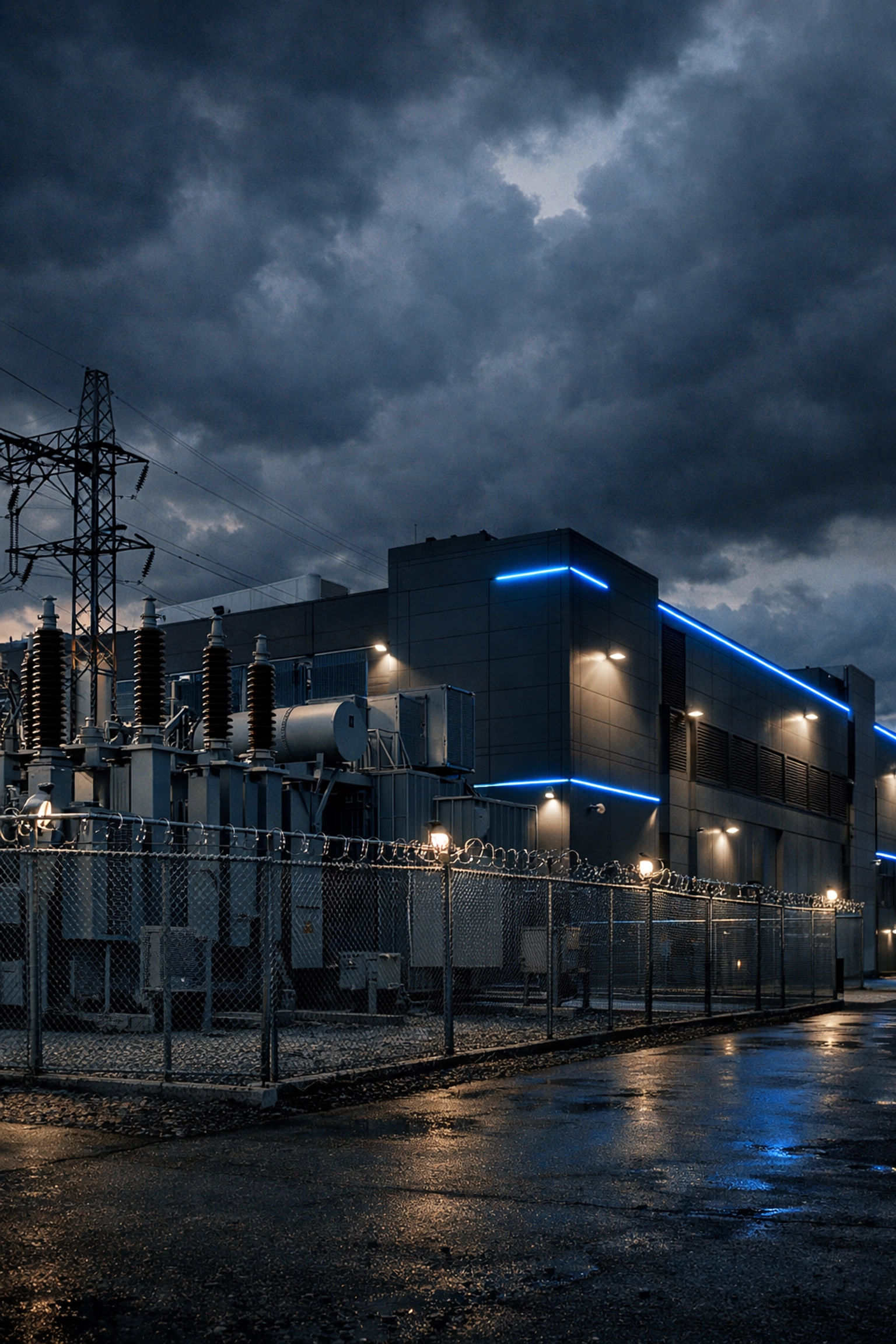
These projects need dedicated substations, redundant power feeds, and access to transmission lines that can handle the load without brownouts or bottlenecks. And here's the kicker: building new transmission infrastructure takes years and costs tens of millions of dollars. So when a data center developer is shopping for land, they're not just looking for acreage: they're looking for power-ready acreage.
That's where the value equation changes.
Where the Power Is
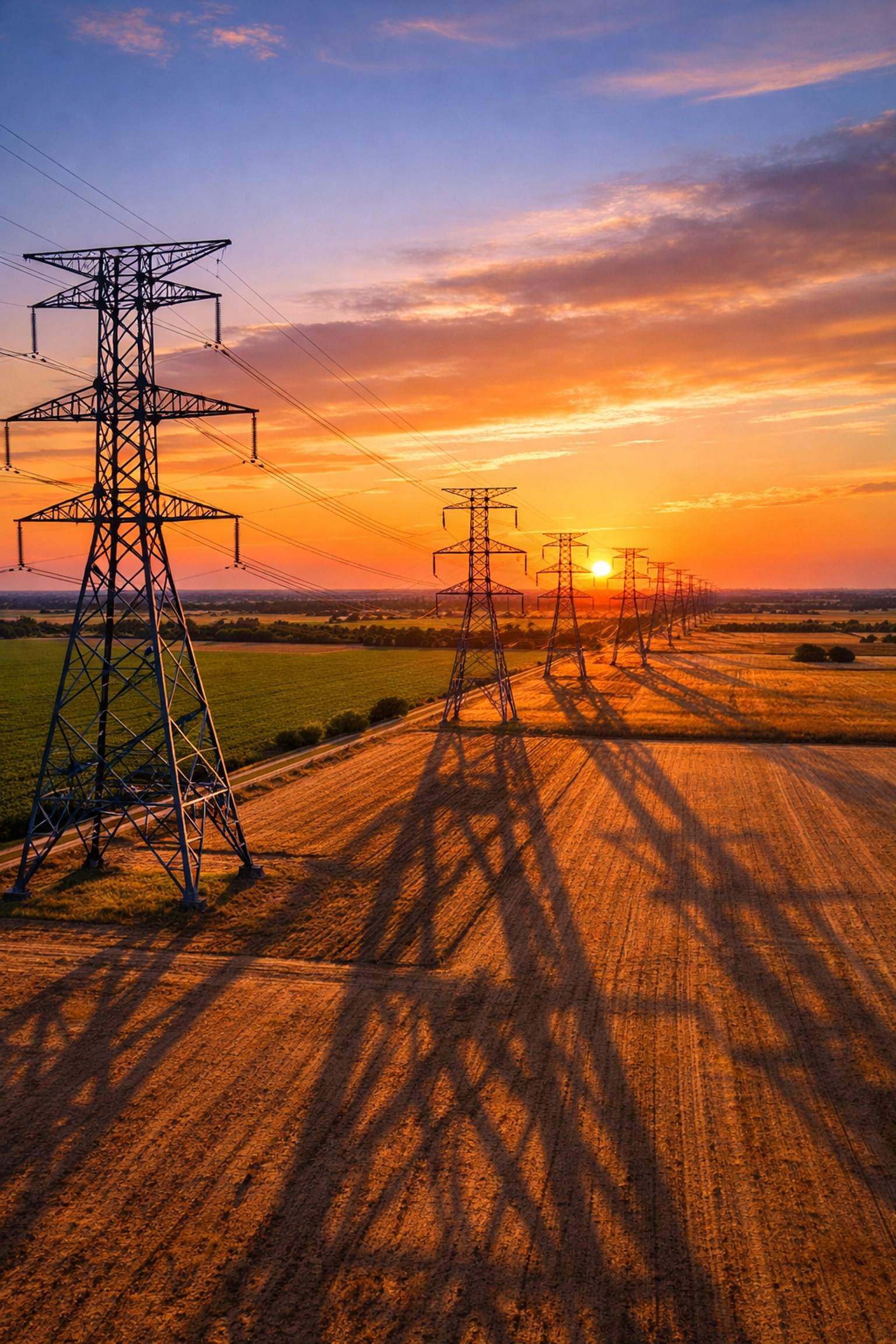
In North Texas, the electric grid is managed by ERCOT (Electric Reliability Council of Texas), and the major transmission corridors run through specific areas. Denton County, Ellis County, and parts of Tarrant County have existing high-capacity transmission lines that were originally built to serve manufacturing and heavy industry. Now, those same corridors are attracting data center investment.
Denton County has seen several major announcements in the last 18 months, with data center developers locking up large tracts near the Oncor substations around Ponder and Krum. These sites are attractive because they already have proximity to 345kV transmission lines and enough capacity to support multiple projects.
Ellis County, particularly around Midlothian and Waxahachie, is seeing similar activity. The industrial infrastructure that was originally built to serve cement plants and manufacturing is now being leveraged for data centers. The power is there, the land is cheaper than Dallas County, and you're still within 40 miles of DFW Airport.
What's happening is a kind of "path of power" rush, similar to the way residential developers chased the path of the tollway. Except instead of following pavement, institutional buyers are following 345kV lines on utility maps.
The Premium for Power-Ready Land
Here's where it gets interesting for landowners. A 100-acre tract with highway frontage might sell for $50,000 to $75,000 per acre in Ellis County, depending on zoning and access. But if that same tract sits within a mile of a substation with available capacity and the right voltage, data center buyers might pay $100,000+ per acre: because the alternative is spending $20 million to build new transmission infrastructure.
The premium isn't just theoretical. We're seeing it play out in real time. Large institutional buyers are targeting sites based on power availability first, location second. They'll accept a site that's five miles off the highway if it's next to a substation. They won't touch a site with perfect visibility if the nearest transmission line is ten miles away.
This is a fundamentally different calculus than residential or even traditional industrial development. For most projects, power is an afterthought: something you coordinate with the utility company once the land is under contract. For data centers, power is the entire site selection process.
What This Means for Landowners
If you own land in Denton, Ellis, or Tarrant counties, the first thing you should do is check the proximity to transmission infrastructure. Oncor and other utilities publish substation maps, and your broker should be able to help you identify whether your property sits in a "power corridor."
Even if you're not planning to sell to a data center developer, understanding this dynamic matters. Because when a hyperscale facility gets built nearby, it tends to trigger secondary development: warehouse projects, logistics hubs, and industrial parks that want to cluster around the data center for connectivity and redundancy.
We've seen this play out in other markets. Northern Virginia, Phoenix, and Dallas all experienced land appreciation in areas surrounding data center clusters. The facilities themselves don't create a lot of jobs, but they do create demand for ancillary infrastructure: fiber networks, cooling systems, backup power generation, and logistics support.
If you're sitting on 50 to 200 acres near a substation and you're not sure what the highest and best use is, it's worth having a conversation about whether the data center market makes sense. Not every site will work: these projects need specific topography, zoning, and utility coordination: but the ones that do can command a significant premium.
The Downsides and Realities
Before you start thinking every tract near a power line is a goldmine, let's pump the brakes. Data center land deals are complicated, slow, and often fall apart. These are institutional transactions with long due diligence periods, contingent on utility approvals, and subject to corporate strategy shifts that are completely outside your control.
Data center developers also tend to buy large blocks: 100 acres minimum, often 200+. If you've got 20 acres, you're probably not in the mix unless you're willing to assemble with neighbors.
And here's the other reality: data centers are not popular with local governments. They generate almost no property tax revenue relative to their footprint, they don't create many jobs, and they use a ton of water for cooling. Some cities are actively blocking them through zoning restrictions or moratoriums.
So while the prices are high, the path to closing is narrow. You need the right site, the right buyer, and the right political environment. It's not a layup.

The Long-Term Shift
What's undeniable is that the land market is evolving beyond just "path of progress" and "highway frontage." Infrastructure is becoming more complex, and buyers are segmenting by use case in ways that weren't happening five years ago.
Data centers are just one piece of that shift. Electric vehicle charging stations, solar farms, and battery storage facilities are all driving new land demand based on power availability. We're moving toward a market where utility infrastructure is a critical component of land valuation: not just an afterthought.
For brokers and landowners, that means staying informed about things that used to be boring: substation locations, voltage capacity, transmission line routes, and utility service territories. It's not sexy, but it's the new reality of high-value land deals in 2026.
If you've got land in North Texas and you're wondering whether the "data center dividend" applies to your property, reach out. At Cooper Land Company, we track these trends and help landowners understand where their property fits in the broader market. Because in 2026, the question isn't just "how close are you to the highway?" It's "how close are you to the power?"
The 'Small Lot' Pivot: Fighting High Rates with Density
![[HERO] The 'Small Lot' Pivot: Fighting High Rates with Density](https://cdn.marblism.com/8mB7KP3rQNx.webp)
For the last decade, the North Texas land market was driven by one dominant product: the sprawling single-family home on a half-acre or larger lot. Buyers wanted space, builders wanted margins, and cheap money made it all pencil. At 3% interest rates, a family could afford a 2,500-square-foot house on a big lot in Prosper or Anna without breaking a sweat.
But 2026 looks a lot different. Mortgage rates are sitting in the mid-6% range, and even though they've come down from the 8% spike in 2023, they're nowhere near the lows that fueled the land rush of 2020–2021. That's forced developers to get creative: and what we're seeing now is a major pivot toward smaller lots, tighter developments, and cluster layouts that maximize density without sacrificing profitability.
If you're a landowner or investor watching this shift, it's critical to understand what's happening. Because the type of land that developers want in 2026 is not the same as what they were buying three years ago. And if you're holding a large tract waiting for the "right" buyer, the definition of "right" has changed.
The Interest Rate Problem
Let's start with the math. At 3% interest, a $400,000 mortgage costs a buyer about $1,686 per month (principal and interest). At 6.5%, that same loan costs $2,528 per month: an 850-dollar-a-month difference. For a family making $100,000 a year, that extra $850 is the difference between qualifying for the loan and getting denied.
Builders know this. And they know that if they keep building the same 2,500-square-foot houses on half-acre lots, they're going to price out a huge chunk of the buyer pool. So instead of building fewer homes and waiting for rates to drop, they're pivoting to a product that works at today's rates: smaller homes on smaller lots with lower total prices.
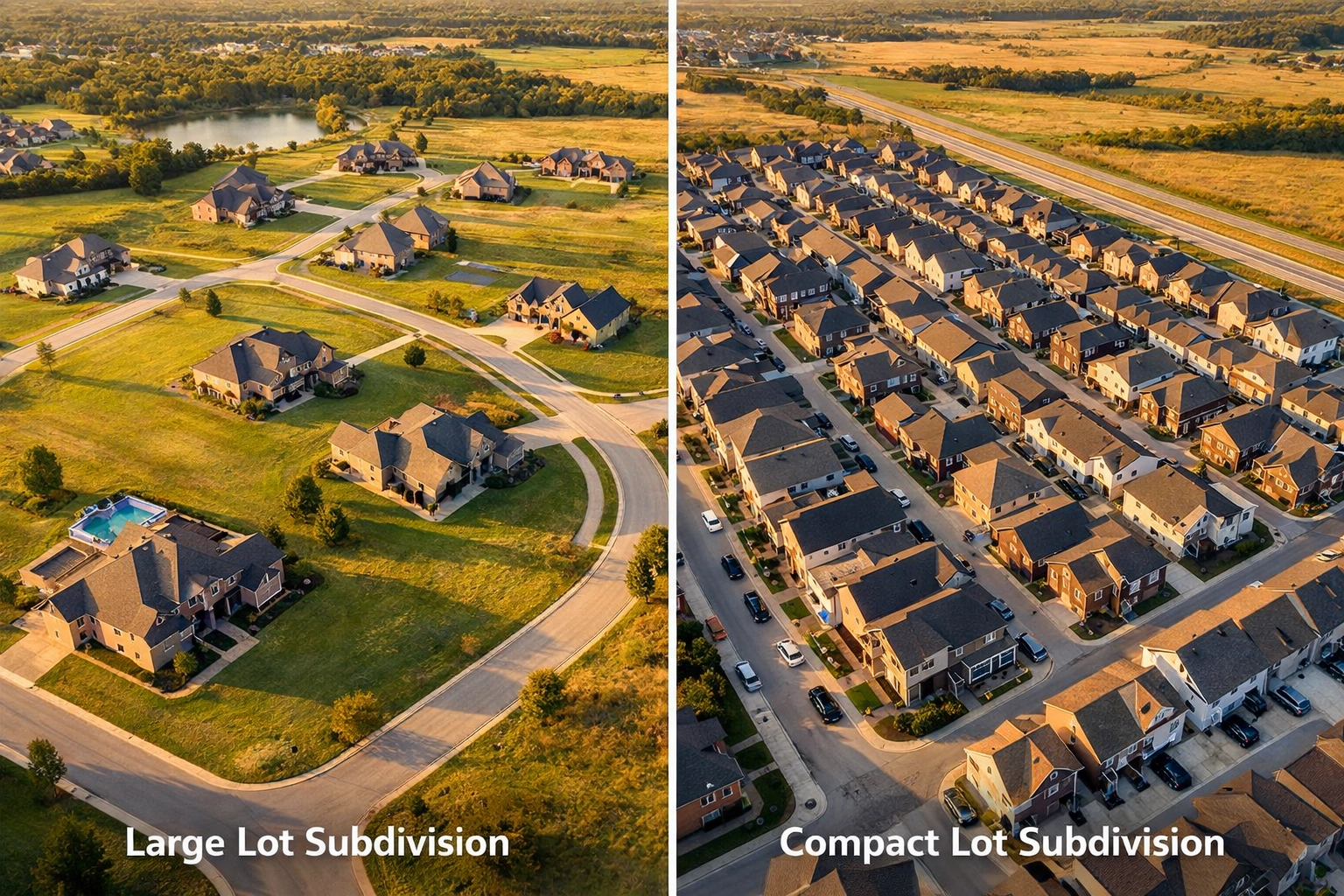
We're seeing subdivisions in Anna, Melissa, and Princeton that are shifting from 50-foot-wide lots to 40-foot-wide lots. Some developers are going even tighter: 35-foot-wide lots in "alley-load" configurations where the garage faces the back of the property instead of the street. The result is that you can fit 30% more homes on the same acreage, and you can price each home $50,000 to $75,000 lower than the big-lot product.
That lower price point brings buyers back into the market, and it allows builders to maintain volume even when rates are sticky.
What This Means for Land Prices
Here's where it gets interesting for landowners. If a developer can fit more homes per acre, they can afford to pay more per acre for the land: up to a point. A tract that used to support 3 homes per acre at 50-foot lots might now support 4 or 5 homes per acre at 40-foot lots. That increased density means the land has more "yield," which increases its value.
But there's a catch: the developer's margin on each home is tighter because they're selling smaller houses at lower prices. So even though they can fit more homes on the land, they're not necessarily willing to pay a linear premium for the acreage. The math gets complicated, and it depends heavily on local zoning, utility costs, and what the market will bear for smaller-lot product.
What we're seeing in the ETJ (extraterritorial jurisdiction) of towns like Anna and Melissa is that developers are paying a modest premium for land that can support higher density: but they're being very selective about which tracts they'll touch. They want sites that are close to existing infrastructure, that can get water and sewer quickly, and that won't require a long fight at the planning and zoning commission.
If your land checks all those boxes, the "small lot pivot" is good news. If it doesn't, you might find that developers are passing on tracts that would have been slam-dunks three years ago.
Zoning and the Density Fight
The biggest wildcard in all of this is zoning. Not every city is on board with higher-density residential development. Some towns: particularly the ones that built their identity around "estate homes" and "rural character": are actively resisting smaller lots through zoning restrictions and minimum lot size requirements.
Prosper, for example, has pushed back against some higher-density projects in certain parts of town, preferring to maintain the larger-lot aesthetic that defined its brand during the boom years. Other cities, like Anna and Princeton, have been more flexible, recognizing that if they don't allow smaller-lot product, builders will just go to the next town over.
The result is a patchwork. Some ETJ areas allow lots as small as 4,500 square feet, while others require a minimum of 10,000 or even 15,000 square feet. For landowners, this means understanding your local zoning is more important than ever. A tract that can support 5 homes per acre in Anna might only support 2 homes per acre in Prosper: and that difference has a massive impact on what a developer is willing to pay.

The Alley-Load Trend
One of the most visible signs of the density pivot is the rise of "alley-load" subdivisions. Instead of every home having a two-car garage facing the street, the garage faces a rear alley. This allows the lots to be narrower (because you don't need as much street frontage for driveways), and it creates a more pedestrian-friendly streetscape with porches and front doors instead of garage doors.
Alley-load layouts aren't new: they've been used in urban infill projects for years: but they're now showing up in suburban greenfield developments as a way to increase density without making the neighborhood feel cramped. Builders like them because they can fit more homes per acre. Buyers tolerate them because the homes are cheaper. And cities are starting to approve them because they check the "walkability" and "New Urbanism" boxes that planning departments love.
For landowners, the question is whether your tract can support an alley-load layout. These projects require extra infrastructure (rear alleys, utility easements, and stormwater management), and they work best on flatter sites with good drainage. If your land is rolling or heavily wooded, an alley-load design might not pencil, and developers will pass.
The "Missing Middle" Opportunity
The other trend we're watching is the rise of "missing middle" housing: townhomes, duplexes, triplexes, and small-lot single-family attached products that sit between traditional single-family subdivisions and apartment complexes. These products allow developers to hit price points in the $250,000 to $350,000 range, which is where a lot of first-time buyers and move-down buyers are shopping.
The challenge is that many North Texas cities don't have zoning categories that easily accommodate missing middle housing. It's not quite single-family, and it's not quite multifamily, so it gets stuck in a gray area. But forward-thinking cities are starting to create "residential light" or "mixed residential" zoning that allows for these products, and developers are responding.
If you own land near an existing city core or along a major corridor like 380 or 75, there's a good chance your property could work for missing middle housing. These projects need less land than traditional subdivisions (10 to 30 acres is the sweet spot), and they can pay a premium per acre because the density is even higher than small-lot single-family.

The Takeaway for Landowners
The shift toward smaller lots and higher density isn't a fad: it's a structural response to higher interest rates and changing buyer demographics. Millennials and Gen Z buyers are more comfortable with smaller homes and tighter neighborhoods than previous generations, and builders are adjusting their product mix to match.
For landowners, this means understanding how your land fits into the new density equation. If you've got a 100-acre tract that was platted for half-acre lots back in 2019, it might be time to revisit the assumptions. A developer looking at that same tract today might want to replat it for 40-foot lots, cluster homes, or even a missing middle product.
At Cooper Land Company, we're helping landowners navigate this shift every day. The land that's moving in 2026 is the land that can support density, get utilities quickly, and fit into a developer's pro forma at today's interest rates. If your tract checks those boxes, you're in a strong position. If it doesn't, we can help you figure out what adjustments make sense: or whether it's better to wait for the next cycle.
The 'Gunter-Tioga' Gap: The Final Frontier of Grayson County
![[HERO] The 'Gunter-Tioga' Gap: The Final Frontier of Grayson County](https://cdn.marblism.com/kR8mN3Bx7Qp.webp)
If you've been following the North Texas land market for the last five years, you've watched the wave move north. It started in Frisco and McKinney, rolled through Celina and Prosper, and now it's pushing hard into Gunter and Anna. The Dallas North Tollway extension has been the single biggest driver of this migration, and every time the frontage roads extend another mile north, land values jump in the next town up the line.
But here's the thing: the wave doesn't stop at Gunter. There's one more gap before you hit the Red River and Oklahoma, and that gap is the Tioga corridor. For long-term land investors who are willing to hold for 7 to 10 years, this is the final frontier of Grayson County: and it's the last place where you can still buy large tracts at pre-development prices before the infrastructure catches up.
Where Gunter Ends and Tioga Begins
Gunter sits right in the path of the tollway extension. The town has seen explosive growth in the last three years, with multiple large-scale residential projects breaking ground and land prices climbing from $15,000 per acre to $50,000+ per acre in prime locations. It's no longer a sleepy farm town: it's a legitimate bedroom community for Dallas commuters who are willing to drive 50 miles for affordable housing.
But once you get north of Gunter, the development starts to thin out. The next town up is Tioga, a small community of about 1,000 people that sits between Gunter and the shores of Lake Ray Roberts. Tioga doesn't have the same infrastructure as Gunter: no major thoroughfares, limited water and sewer capacity, and a slower pace of zoning approvals. But it also doesn't have the same land prices.
Right now, you can still find 50- to 200-acre tracts in the Tioga area for $10,000 to $20,000 per acre. That's less than half of what comparable land costs in Gunter, and it's a fraction of what you'd pay in Celina or Prosper. The reason is simple: there's no immediate catalyst. The tollway is still years away from reaching Tioga, and the infrastructure isn't ready to support large-scale residential development.
But that's exactly why smart money is starting to pay attention.

The Long-Term Infrastructure Play
The Dallas North Tollway is currently under construction through Celina, with plans to extend north to US-380 in the next few years. After that, the next phase will push the tollway toward Gunter, and eventually: potentially by the early 2030s: it could extend all the way to the Grayson County line and beyond.
If that happens, Tioga goes from being "off the map" to being "on the tollway." And the land values will adjust accordingly.
This is the same playbook that worked in Celina ten years ago. Back in 2015, you could buy land in Celina for $8,000 to $12,000 per acre. Investors who bought then and held through the tollway extension are now sitting on land worth $75,000 to $100,000 per acre. The return wasn't instantaneous: it took patience and a willingness to carry the land through the planning and construction phases. But the ones who stayed in the game made generational wealth.
Tioga is the next iteration of that same bet. You're buying land today at pre-infrastructure prices, banking on the fact that the growth corridor will eventually reach you. It's not a short-term flip. It's a hold-and-wait strategy that requires capital, patience, and a strong conviction that North Texas growth doesn't stop at Gunter.
Why Tioga and Not Somewhere Else?
There are other "gap" markets in North Texas: places like Leonard, Whitewright, and Tom Bean that are also sitting in the path of potential growth. So why is Tioga the focus?
The answer is geography. Tioga sits directly north of Gunter on FM 1959, which is a straight shot from Celina. It's also adjacent to Lake Ray Roberts, which adds a recreational and lifestyle component that other rural markets don't have. Developers love lakefront proximity because it gives them a marketing angle: even if the actual development isn't on the water, being "near the lake" adds perceived value.
Tioga also benefits from being in Grayson County, which has a more business-friendly regulatory environment than some of the surrounding counties. Grayson has been aggressive in courting large employers (like Texas Instruments and the recent silicon manufacturing projects), and that economic activity creates spillover demand for housing and land development.
Finally, Tioga is close enough to Sherman and Denison that you can access higher-order services (hospitals, shopping, entertainment) without driving all the way back to Dallas. That "secondary city" proximity is important for long-term development, because it means residents don't have to rely 100% on the metroplex for their daily needs.

The Risks and Realities
Let's be clear: buying land in Tioga today is not a sure thing. There are very real risks that come with betting on a market that's still 5 to 10 years away from major infrastructure.
Infrastructure Delays: The tollway extension could get delayed, defunded, or rerouted. TxDOT and NTTA have a history of adjusting timelines based on budgets and political priorities. If the tollway doesn't make it to Tioga in the timeframe you're expecting, your land could sit idle for longer than you planned.
Water and Sewer: Tioga doesn't currently have the water and sewer capacity to support large-scale development. Developers will need to work with regional water districts or build their own package plants, which adds cost and complexity. Some tracts will pencil, others won't.
Zoning and Regulation: Small towns can be unpredictable when it comes to growth. Tioga might embrace development, or it might push back and try to maintain its rural character. You won't know until a developer actually submits a plat and goes through the approval process.
Market Timing: If you're buying land in Tioga today with the expectation of selling in 7 to 10 years, you're betting that the North Texas market will still be strong a decade from now. Economic recessions, interest rate spikes, and demographic shifts could all impact that timeline.
None of these risks are dealbreakers, but they're real. This is a patient capital play, not a quick flip.
Who's Buying in the Gap?
The buyers we're seeing in the Tioga area right now fall into three categories:
- Long-term land investors who are comfortable holding for a decade and who have the capital to carry the land without generating income from it.
- 1031 exchange buyers who are rolling proceeds from a recent sale into a land hold and who are okay with a longer investment horizon.
- Legacy buyers who are purchasing land for their kids or grandkids, with no intention of developing or selling in their own lifetime.
These are not the same buyers who are competing for land in Celina or Prosper. The Tioga market is quieter, slower, and less competitive. But that's also what makes it attractive. You're not bidding against ten other guys on every tract that comes to market.

The Lake Ray Roberts Factor
One wildcard that sets Tioga apart is its proximity to Lake Ray Roberts. The lake is a major recreational asset, and it's surrounded by state parks, marinas, and weekend home communities. As North Texas continues to grow, lakefront and lake-adjacent land is becoming increasingly valuable: not just for primary residences, but for second homes, short-term rentals, and lifestyle developments.
We've seen this play out at other Texas lakes. Lake Travis near Austin, Lake Conroe near Houston, and Lake Lewisville near Dallas have all experienced land appreciation as urban sprawl pushes closer to the water. Tioga sits on the edge of that same dynamic.
Developers are starting to explore "agri-hood" and lake-lifestyle concepts in Tioga: developments that blend rural acreage with proximity to water recreation. These aren't traditional suburban subdivisions; they're 5- to 10-acre estate lots marketed to buyers who want space, privacy, and access to the lake without giving up connectivity to the metroplex.
If that trend continues, Tioga could become a high-end residential market in addition to being a future suburban growth corridor. And land that's priced for agricultural use today could end up being worth lakefront-adjacent prices in ten years.
The Takeaway
The Gunter-Tioga gap is the last big bet in Grayson County before you run out of land and hit Oklahoma. It's not for everyone: it requires capital, patience, and a tolerance for uncertainty. But for investors who believe that North Texas growth doesn't stop at the 380 corridor, Tioga represents one of the last opportunities to buy large tracts at pre-development prices before the wave arrives.
At Cooper Land Company, we're actively tracking this market and helping investors identify tracts that have the best long-term potential. Not every piece of land in Tioga is going to work: some are too far from future infrastructure, some don't have good access, and some will never get utilities. But the ones that do check the boxes? Those are the generational holds.
If you're interested in exploring the Tioga opportunity, reach out. We'll walk you through the infrastructure timelines, the zoning realities, and the long-term projections. Because in 2026, the best land deals aren't always the ones that are ready to break ground tomorrow: sometimes they're the ones that won't be ready for another decade.
OUR LISTINGS

© 2026 Cooper Land Company
DMCA Notice | Terms & Services | Privacy Policy | Accessibility Statement
EQUAL HOUSING OPPORTUNITY



Cooper Land Company
2501 Greenspoint Ln, Prosper, TX 75078
Mobile: 214-714-5638
dan@cooperlandcompany.com