The 'Gunter-Tioga' Gap: The Final Frontier of Grayson County
![[HERO] The 'Gunter-Tioga' Gap: The Final Frontier of Grayson County](https://cdn.marblism.com/9Ob3LnTOfzL.webp)
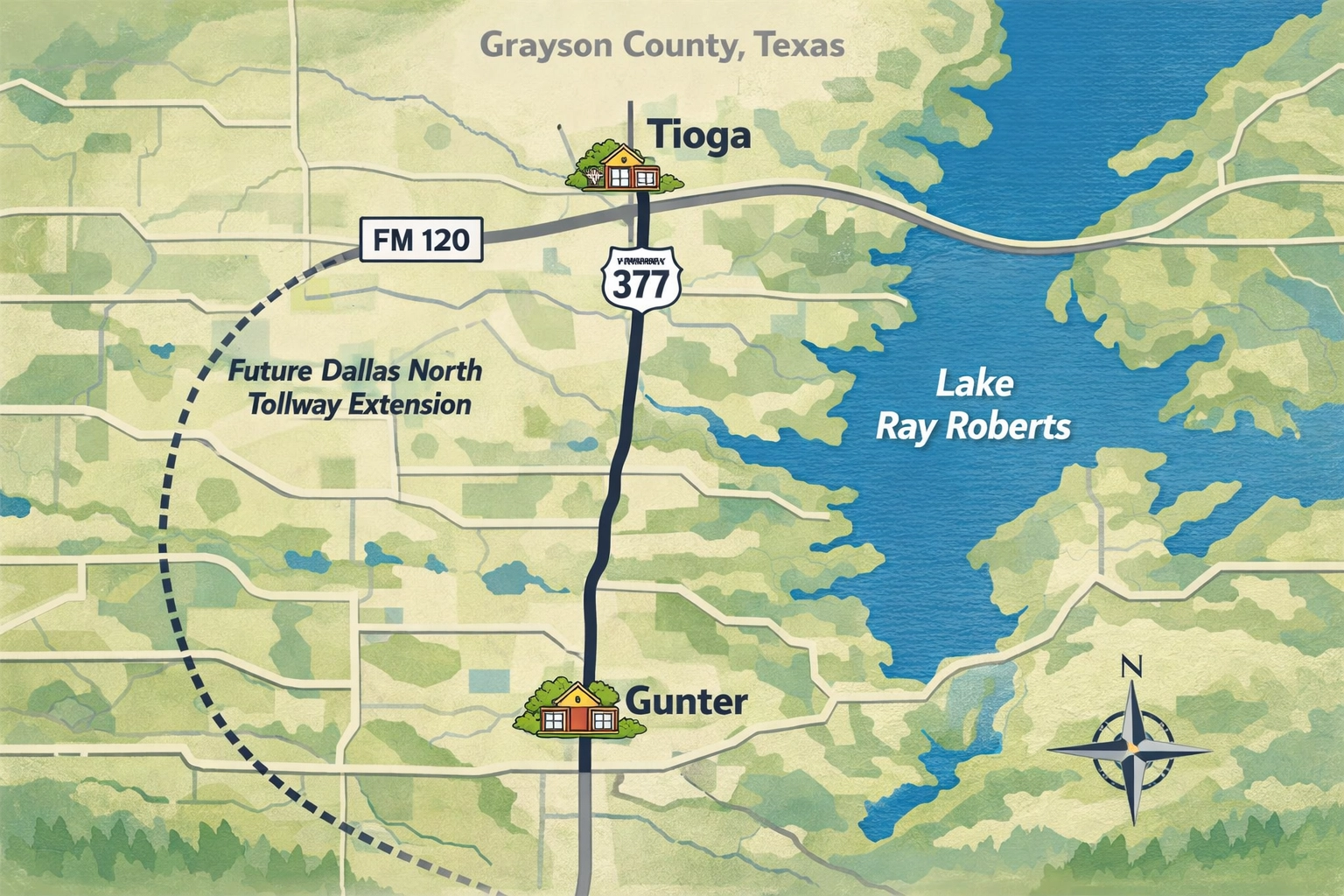
Everyone's talking about Gunter. And they should be. With the Dallas North Tollway extension inching closer every quarter, Gunter has firmly planted itself as the "next Celina" in most investor conversations. But here's what the smart money is already doing: they're looking one town further north, toward the 10-mile stretch between Gunter and Tioga that hugs the western edge of Lake Ray Roberts.
I'm calling it the "Gunter-Tioga Gap," and if you're thinking 10+ years out, this is where the final chapter of Grayson County's residential explosion gets written.
Why the Gap Matters
The DNT extension isn't stopping at Gunter. The long-term plan has always been to push the tollway north toward Sherman, and that means the area between Gunter and Tioga: currently a mix of ranch land, small farms, and lake-access properties: sits directly in the path of progress. Right now, it's quiet. But quiet doesn't mean overlooked.

Here's the reality: by the time the tollway reaches Gunter and developers start breaking ground on the first master-planned communities, the land pricing in town will already reflect the "arrived" premium. That's when institutional buyers, family offices, and patient investors pivot to the next logical step: the land that's about to be in the path, not the land that's already there.
The Gunter-Tioga Gap is that next step.
The Lake Ray Roberts Advantage
One of the biggest differentiators for this area is proximity to Lake Ray Roberts. While most of the DNT corridor from Frisco to Prosper to Celina has been landlocked suburban sprawl, the stretch north of Gunter offers something different: water access, scenic views, and the kind of lifestyle amenities that create premium pricing.
We're already seeing this play out in other lake markets. Look at what happened around Lake Lewisville in Denton County or the luxury shift happening on the east side of Lake Ray Hubbard in Rockwall County. Water proximity doesn't just add value: it changes the type of buyer you attract. And that shift usually happens before the tollway gets there, not after.
The land between Gunter and Tioga is positioned to capture both the commuter demand moving north out of Collin County and the second-home and luxury estate demand tied to the lake. That's a rare combination in North Texas.
What's Driving the Long-Term Thesis
If you're looking at this area as a 1–3 year flip, you're probably early. But if you're underwriting for a 7–15 year hold, the thesis is rock-solid. Here's why:
1. The Tollway is the Tailwind
The DNT extension timeline keeps getting refined, and while construction dates shift, the direction doesn't. The tollway is coming north, and every feasibility study, traffic model, and regional growth plan assumes it. Land in the direct path of future tollway access has historically appreciated 3x–5x in the decade leading up to and following construction.
2. Grayson County's Job Growth is Accelerating
Texas Instruments' Sherman facility and GlobiTech's data center projects have fundamentally changed the employment base in Grayson County. Thousands of high-paying jobs are landing in a county that, five years ago, most people associated with rural living and weekend lake trips. That employment shift creates housing demand, and housing demand eventually pushes the development line north.
3. Infrastructure is Coming (Slowly, but Coming)
One of the biggest hurdles for development in the ETJ areas between Gunter and Tioga has been water and sewer capacity. But we're seeing progress. Gunter is investing heavily in utility expansion, and Grayson County has prioritized infrastructure improvements along FM 120 and other key corridors. It's not fast, but it's happening: and that's exactly the kind of groundwork that precedes large-scale residential development.

4. The 'Affordable Luxury' Play
As land prices in Collin County push past $150,000 per acre for development tracts, buyers looking for estate lots, agri-hoods, or low-density luxury communities are getting priced out. The Gunter-Tioga Gap offers a middle ground: you're still close enough to the Tollway (eventually) to justify premium home pricing, but you're far enough out that land is still trading in the $20,000–$40,000 per acre range for large tracts.
That spread creates the opportunity for patient capital to lock in acreage now and wait for the market to mature.
What to Look For
If you're serious about buying in the Gap, here's what we're focused on:
Highway 377 and FM 120 Corridors: These are the primary north-south arteries connecting Aubrey, Pilot Point, and Tioga to Gunter. Proximity to these roads: especially with future tollway interchange speculation: is critical.
Water Access or Water Views: Not every tract needs to be lakefront, but proximity to Lake Ray Roberts adds a lifestyle premium that can't be replicated in landlocked developments. Look for properties within 2–3 miles of the lake with potential view corridors.
Larger Tracts (50+ Acres): The development pattern in this area will likely lean toward estate lots, conservation subdivisions, or low-density master plans. Smaller tracts are harder to monetize unless they have unique features like highway frontage or utilities already stubbed.
Utility Feasibility: Before you buy, understand the water and sewer situation. Some areas will require package treatment plants or well/septic systems, which limits your development options. Work with engineers early to validate feasibility.
ETJ Positioning: Land inside the Extraterritorial Jurisdiction (ETJ) of Gunter or Tioga has more development flexibility than county-regulated land. Understand the annexation risk and opportunity before you close.
The Timing Question
Here's the part where I talk you off the ledge if you're expecting a quick flip: this is a long-term play. If you're buying in 2026, you're probably not selling until the early 2030s at the earliest. That's not a bug; it's a feature. The land investors who made generational wealth in Frisco, Prosper, and Celina weren't the ones who flipped after 18 months. They were the ones who bought in the path of progress and held through multiple market cycles.
The Gunter-Tioga Gap is in that same position today. The fundamentals are lining up, but the market hasn't caught up yet. That's the window.
The Risks
Let's be honest about the downside. The biggest risk is time. If the DNT extension gets delayed by five years, or if Grayson County's job growth slows, your capital is sitting in a non-productive asset. Carrying costs: property taxes, insurance, maintenance: add up over a decade. This isn't a play for someone who needs liquidity in three years.
The second risk is infrastructure. If water and sewer solutions don't materialize, the development potential of your land gets capped. That's why engineering due diligence is non-negotiable.
Finally, there's the risk of regulatory change. Annexation, zoning restrictions, or environmental protections around Lake Ray Roberts could all impact development feasibility. Work with a land-use attorney before you close on any significant tract.
Why We're Watching This Closely
At Cooper Land Company, we've been tracking the Gunter-Tioga corridor for the last 18 months. We've walked properties, talked to engineers, reviewed utility maps, and modeled out multiple development scenarios. The conclusion? This is one of the last "pre-growth" opportunities in the greater North Texas market where institutional capital hasn't fully arrived yet.
That doesn't mean every tract is a winner. But for buyers who understand the timeline, can afford to hold, and are willing to do the infrastructure homework, the Gunter-Tioga Gap represents the kind of asymmetric opportunity that only shows up once or twice in a market cycle.
If you're looking at land in Grayson County and you're focused on the usual suspects: downtown Sherman, the Highway 75 corridor, or Gunter proper: you're not wrong. But you're also paying for certainty. The Gap is where you pay for potential.
And in North Texas, potential has a pretty strong track record of turning into performance.
Looking at land in the Gunter-Tioga area? Let's walk it together. At Cooper Land Company, we specialize in long-term development tracts and path-of-progress positioning. Reach out and let's talk about what makes sense for your timeline.
OUR LISTINGS

© 2026 Cooper Land Company
DMCA Notice | Terms & Services | Privacy Policy | Accessibility Statement
EQUAL HOUSING OPPORTUNITY



Cooper Land Company
2501 Greenspoint Ln, Prosper, TX 75078
Mobile: 214-714-5638
dan@cooperlandcompany.com