The 'Interstate 30' Eastward Push: Why Royse City and Fate are Exploding
![[HERO] The 'Interstate 30' Eastward Push: Why Royse City and Fate are Exploding](https://cdn.marblism.com/JscBDM0Quq_.webp)
Everyone talks about Collin County. McKinney, Prosper, Celina: they're the darlings of the North Texas growth story. But if you're looking at where the next wave is building, you need to shift your focus about 30 miles east along Interstate 30. Royse City and Fate are exploding, and for developers who've been priced out of the "golden corridor," this is the new entry point.
The math is simple: Collin County got expensive. Rockwall and Hunt counties are finally catching up on infrastructure. And the I-30 corridor is becoming the practical alternative for both homebuyers and land developers who still want proximity to Dallas without paying Frisco prices.
The Rockwall Effect: Population Boom Driving Everything
Rockwall County isn't just growing: it's one of the fastest-growing regions in the entire country. Between 2021 and 2022 alone, the county added more than 120,000 people, a 5.7% increase that placed it sixth nationally for population gain during that period. That's not a typo. We're talking about a county that was once known as a quiet lake community suddenly absorbing small-city-level population growth in a single year.
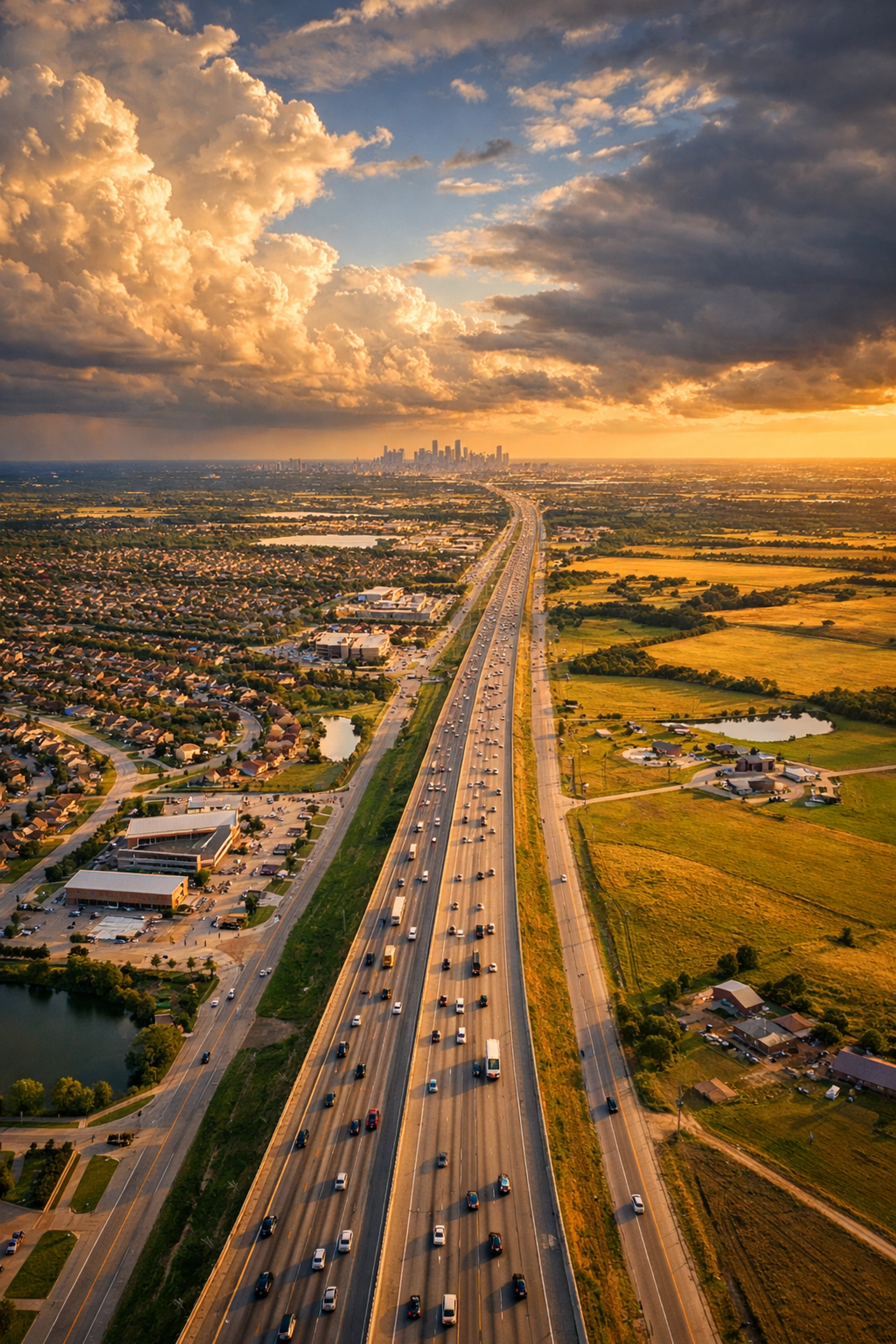
When growth hits that fast, everything gets strained. Schools, roads, grocery stores, emergency services: the whole system has to scramble to keep up. And the biggest bottleneck? Interstate 30. The stretch behind Royse City became the most congested highway section in Texas. Not just North Texas: all of Texas. That's the kind of pressure that forces infrastructure investment, and TxDOT finally responded.
The $348 Million Fix: TxDOT's I-30 Expansion
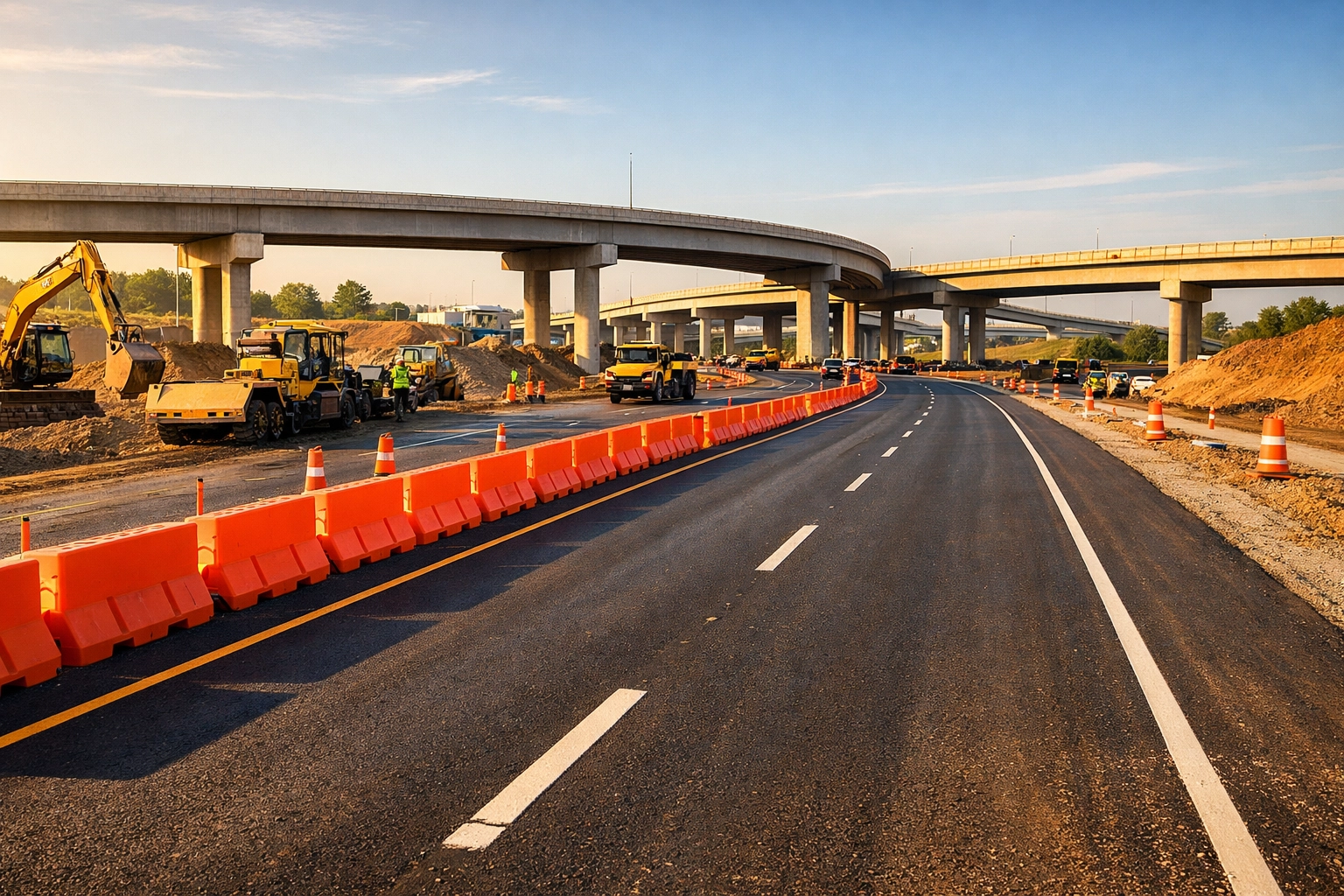
TxDOT is in the middle of a massive 17-mile widening project from Bass Pro Drive all the way to the Hunt County line. Four-lane sections are expanding to six lanes. Six-lane sections are getting even wider. They're adding continuous frontage roads: including across Lake Ray Hubbard: and rebuilding multiple interchanges to handle the load.
The project is split into multiple segments with completion dates extending into 2026 and beyond. The total investment? Over $348 million. That's not maintenance: that's a statement. TxDOT is acknowledging that this corridor is no longer a secondary route. It's a primary artery for one of the fastest-growing metro regions in the country.
For land investors and developers, that infrastructure investment is the green light. When the state drops hundreds of millions into road capacity, it's a signal that the growth is real, permanent, and accelerating.
Why Developers are Moving East
Collin County prices have reached a point where even experienced developers are struggling to make the numbers work. A 50-acre development tract in Anna or Melissa that would've been $3 million in 2019 might be $8-10 million today. For a regional or national builder trying to deliver an "affordable" product (anything under $400k), that land basis is nearly impossible to pencil.
Enter Royse City and Fate.
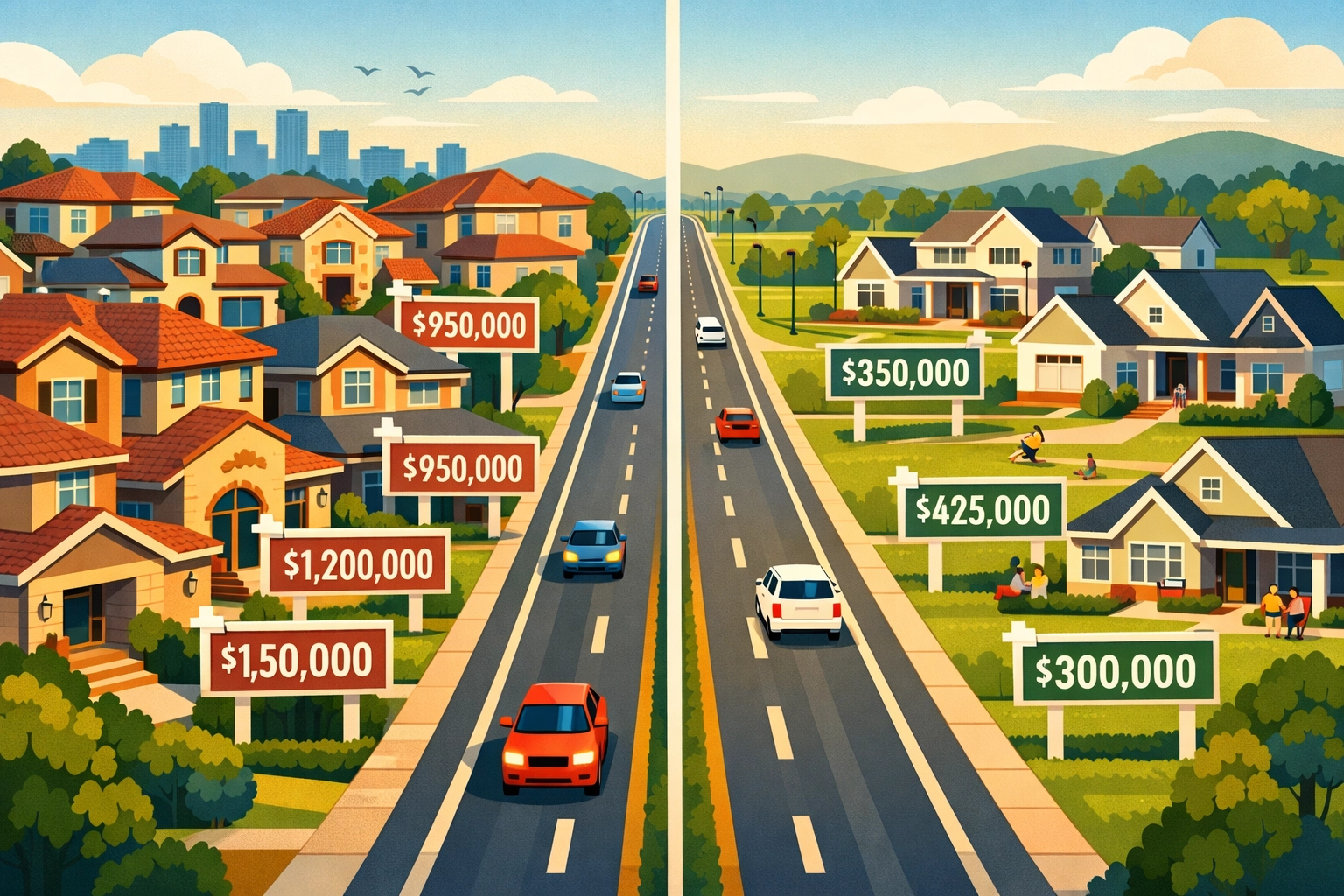
These towns sit right in the path of the eastward migration, but the land is still trading at $40,000-$60,000 per acre for development-ready tracts: sometimes less if you're willing to take on zoning and utility work. That's a fraction of what you'd pay in Collin County, and you're still only 30-35 minutes from downtown Dallas via I-30.
The calculus for developers is straightforward: buyers who can't afford a $450k house in Prosper can afford a $350k house in Royse City. And if the commute is only five minutes longer thanks to the highway expansion, it's not a sacrifice: it's a smart trade-off.
Infrastructure Finally Catching Up
The dirty secret of North Texas growth is that infrastructure almost always lags behind demand. Cities approve plats, builders start framing houses, and then everyone realizes the roads, water systems, and schools can't handle the load. It's the classic "build first, fix later" problem.
But Rockwall and Hunt counties are in a different phase now. The infrastructure is starting to catch up. The I-30 expansion is the most visible piece, but there's more happening behind the scenes:
- Water and sewer extensions: Royse City and Fate are both expanding their municipal water and wastewater capacity to serve new developments.
- School district investment: Royse City ISD and Rockwall ISD are both in growth mode, building new campuses to handle enrollment increases.
- Retail and commercial: The "amenity gap" that used to make these towns feel isolated is closing. New shopping centers, restaurants, and healthcare facilities are following the rooftops.
When you combine all of that with the highway expansion, you get a corridor that's finally ready to absorb serious development volume without feeling like a construction zone for the next decade.
The "Entry Level" Developer Opportunity
One of the most interesting dynamics in the Royse City/Fate market is the shift in buyer profile. These aren't just individual families looking for affordable housing. It's also institutional buyers, smaller regional builders, and Build-to-Rent (BTR) developers who are scooping up 20-50 acre tracts.
For developers who were priced out of Collin County or who don't want to fight for scraps in a hyper-competitive market, this is the "entry level" play. The land is still affordable enough to make the pro forma work. The entitlement process in Royse City and Fate is more streamlined than dealing with some of the larger Collin County cities. And the demand is absolutely there.
Here's what we're seeing on the ground:
- Single-family subdivisions: 100-200 lot developments targeting the $300k-$400k price range.
- Build-to-Rent communities: 150-300 unit BTR projects designed for renters who want suburban space but can't (or won't) buy.
- Ag-to-residential rezoning: Developers buying larger 100+ acre ag tracts and working through the zoning process to convert them into residential plats.
The key for all of these deals is the same: get in before the land basis jumps. Right now, you can still find tracts in the $40k-$60k per acre range if you know where to look. But as the I-30 expansion wraps up and the first wave of new subdivisions starts closing, those prices are going to climb fast.
What's Driving the Buyer Demand?
The demand side of this equation is just as important as the supply side. Why are homebuyers willing to move 30 miles east instead of staying closer to Dallas or Plano?
Affordability: The median home price in Collin County is well over $500k. In Rockwall County, it's closer to $400k, and in parts of Royse City and Fate, you can still find new construction under $350k. For first-time buyers or families who need space but don't have a million-dollar budget, that difference matters.
Space: The typical lot size in a Royse City subdivision is 6,000-8,000 square feet. In some of the newer Collin County developments, you're lucky to get 5,000. Buyers who want a real yard, room for a playset, or just some breathing room are willing to drive a bit further for it.
Quality of Life: Rockwall County still has that "small town" feel even as it grows. The school ratings are solid, crime is low, and there's a sense of community that's harder to find in some of the more congested suburban cities.
Add it all up, and you get a buyer pool that's motivated, qualified, and ready to make the trade-off of a slightly longer commute for better value and more space.
The Long-Term Bet: I-30 as the New Growth Spine
If you're thinking long-term, the I-30 corridor is positioning itself as one of the next major growth spines in North Texas. We've already seen this pattern play out with US-380, the Dallas North Tollway, and SH-121. The highway gets upgraded, development follows, and suddenly you're looking at a continuous string of suburban growth stretching 40-50 miles.
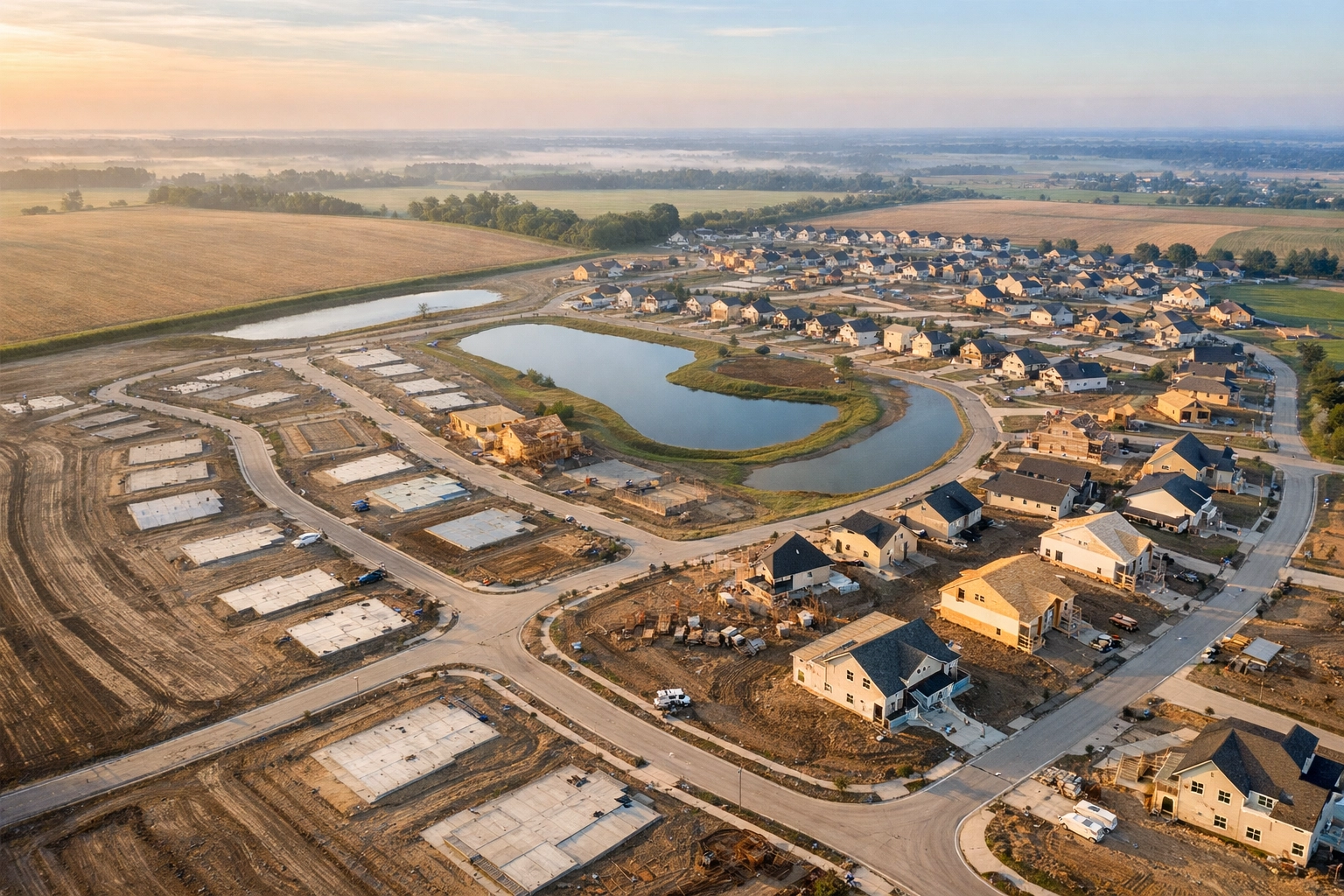
I-30 is on that same trajectory. As Rockwall fills in, the pressure pushes east into Hunt County. As Hunt County develops, the next ring moves further out. It's the concentric circle pattern that's defined North Texas growth for decades, and right now, Royse City and Fate are sitting right in the sweet spot.
For land investors, the play is straightforward: identify tracts that are close to the highway, have utility access (or can get it), and sit in the path of the next wave of annexation and zoning changes. Those are the parcels that will see the biggest value appreciation over the next 5-10 years.
What to Watch in 2026
As we move through 2026, here are the key indicators that will tell you whether the I-30 eastward push is accelerating or stalling:
- Completion of the I-30 expansion: The more TxDOT finishes, the faster the corridor becomes viable for daily commuters.
- Builder activity: Watch for the major national and regional builders to start announcing new projects. When DR Horton, Lennar, or Taylor Morrison enter a market, it's a validation signal.
- Retail anchors: The first big grocery store or retail center in a growing town is always a milestone. It signals that the population has reached critical mass.
- Land price comps: Track the per-acre pricing on recent development tract sales. If you start seeing $80k-$100k per acre becoming the norm, the entry-level window is closing.
Final Thoughts
The I-30 eastward push isn't speculation: it's already happening. Royse City and Fate are absorbing population, infrastructure is catching up, and developers are lining up to get in while the land is still affordable. If you're a buyer, builder, or investor who's been priced out of Collin County, this is the corridor to focus on.
The North Texas growth story isn't slowing down. It's just moving 30 miles east along the freeway. And for the folks paying attention, that's where the next round of value creation is going to happen.
If you're looking at land opportunities in Rockwall or Hunt County, or you want to understand how the I-30 expansion affects your holdings, let's talk. We track this corridor daily, and we can help you position for what's coming next.
OUR LISTINGS
© 2026 Cooper Land Company
DMCA Notice | Terms & Services | Privacy Policy | Accessibility Statement
EQUAL HOUSING OPPORTUNITY



Cooper Land Company
2501 Greenspoint Ln, Prosper, TX 75078
Mobile: 214-714-5638
dan@cooperlandcompany.com