Beyond the MUD: How 'Package Plants' are Opening up Rural Denton County
Beyond the MUD: How 'Package Plants' are Opening up Rural Denton County
![[HERO] Beyond the MUD: How 'Package Plants' are Opening up Rural Denton County](https://cdn.marblism.com/CMJNVgQeCeV.webp)
The conventional wisdom in North Texas development has always been simple: follow the pipes. If the city sewer lines haven't reached your tract yet, you're essentially sitting on the bench waiting for the game to come to you. That wait could be five years, ten years, or in some cases, never.
But something's changed in the last 24 months. Developers are suddenly taking serious looks at 40-80 acre parcels in Justin, Northlake, and the western edges of Denton County: areas that conventional thinking would've written off as "too far out" just a few years ago. The reason? Package plants are rewriting the rules about what's developable and what's not.
The Infrastructure Bottleneck
Let's talk about the real problem first. Municipal Utility Districts (MUDs) have been the traditional solution for bringing water and wastewater service to undeveloped land. A developer forms a MUD, issues bonds to fund infrastructure, and eventually the city assumes control once the development is built out. It's a proven model, but it comes with some serious constraints.
MUDs work great for larger projects: think 200+ acres with hundreds of planned homes. The bond capacity justifies the infrastructure investment. But for that sweet spot of 40-80 acres? The economics get fuzzy. You're looking at the same per-unit infrastructure costs but with fewer rooftops to spread them across. Add in the political complexity of forming a MUD, the time lag, and the uncertainty of city annexation timelines, and suddenly those "in-between" tracts become hard to pencil out.
That's left a lot of well-located land sitting idle, even in high-growth corridors where demand is strong.
Enter the Package Plant
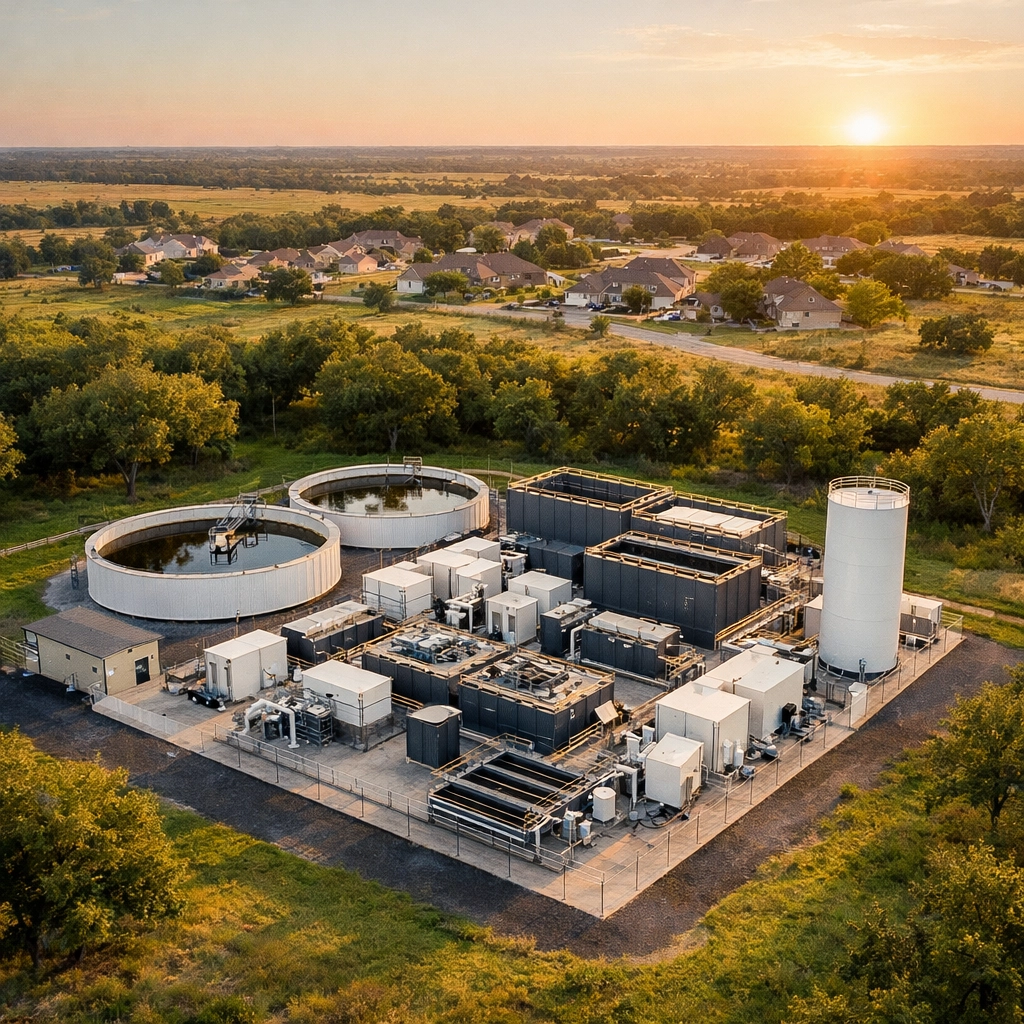
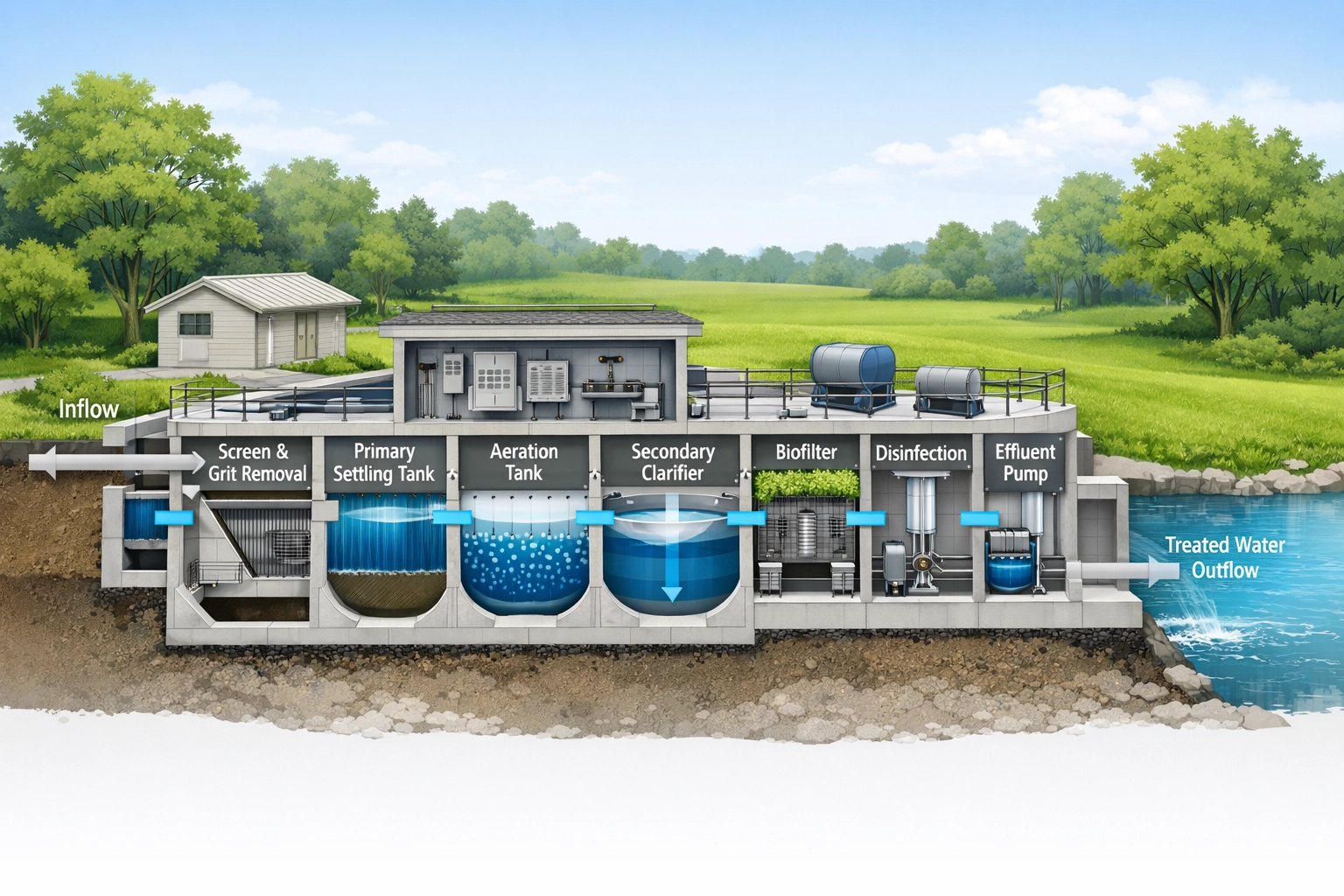
A package plant: sometimes called a packaged wastewater treatment system: is essentially a self-contained, modular treatment facility. Think of it as the wastewater equivalent of a backup generator. Instead of waiting for the city to extend sewer lines five miles down the road, you install your own treatment system right on-site.
These aren't the septic systems your grandfather used. Modern package plants use advanced treatment processes: extended aeration, membrane bioreactors, and sequencing batch reactors: that can meet or exceed municipal discharge standards. They're compact, relatively low-maintenance, and scalable. A system designed for 50 homes might fit on less than half an acre.
The key advantage? Speed and flexibility. You're not waiting on bond elections, county approvals, or city extension plans. If your land has access to water supply (either through a water district or wells) and you can meet TCEQ discharge requirements, you can move forward.
Why Denton County is the Testbed
Denton County: particularly the western half: is where this trend is really taking off. Towns like Justin (population around 4,500) and Northlake (population under 4,000) are in the direct path of DFW's northwestern expansion, but they're still 5-10 years away from full city infrastructure in many pockets.
Developers are looking at these areas and seeing the same dynamics that made Prosper and Celina hot markets a decade ago: good schools, highway access (I-35W and US-380), affordable land, and strong buyer demand from families priced out of closer-in suburbs. The only thing missing? The pipes.
Package plants solve that problem. A builder can acquire 60 acres in Justin, install a treatment system, and bring homes to market in 18-24 months instead of waiting half a decade for a MUD to form and build out infrastructure. That time advantage translates directly into profit: you're catching the current market cycle instead of hoping demand is still strong when the city finally gets around to your area.
The Economics of Decentralized Systems
Let's talk numbers, because that's what matters. A package plant for a 50-home development might run $750,000 to $1.2 million installed, depending on site conditions and the level of treatment required. That sounds like a lot, but compare it to the alternative:
- MUD formation costs: $200,000–$400,000 in legal and administrative fees
- Bond issuance: 4-6% interest over 20-30 years
- Infrastructure construction: $15,000–$25,000 per lot for water and sewer lines
- Time delay: 3-5 years from MUD formation to first home sales
When you add up the carrying costs on land (taxes, debt service, opportunity cost) over that 3-5 year window, the package plant starts looking pretty attractive. You're essentially trading a one-time capex investment for speed-to-market and control.
There's also the exit strategy angle. Once your development is built out and the city infrastructure eventually reaches your area, you can often negotiate a deal to decommission the package plant and connect to city sewer. Some cities will even buy the system from you as part of the annexation process. You've essentially de-risked the project by not betting everything on infrastructure timing you can't control.
Regulatory and Technical Considerations
Of course, it's not as simple as dropping a prefab plant on your property and calling it good. TCEQ (Texas Commission on Environmental Quality) regulates package plants, and you'll need to secure a discharge permit. That means demonstrating that your treated effluent meets water quality standards for whatever receiving stream or drainage feature it discharges into.
Site selection matters. You need adequate land for the treatment system itself, plus a spray irrigation field or other disposal method if you're not discharging directly to a waterway. Soil percolation rates, groundwater depth, and proximity to surface water all factor into the engineering.
You'll also need to set up a maintenance plan. Package plants require regular monitoring and periodic service: think of it like maintaining a pool system, not just setting and forgetting. Many developers establish a property owners' association that takes over operations once the development is complete, or they contract with a third-party operator. Monthly operating costs typically run $500-$1,500 depending on system size.
The good news? These are all solvable problems if you plan for them upfront. The technology is proven, the regulatory pathway is clear, and there are experienced engineering firms that specialize in exactly this type of project.
Where Cooper Land Company Fits In
This is where local knowledge becomes critical. Not every 60-acre tract in rural Denton County is a good candidate for a package plant development. You need to understand the soil conditions, the drainage patterns, the local utility districts' future plans, the city's annexation timeline, and the school district boundaries that drive buyer demand.
We've been working with developers to identify these "off-grid" opportunities for the past few years, and the evaluation process is more nuanced than just looking at a price-per-acre. We're analyzing whether the site has favorable topography for effluent disposal, whether the local water supply district has adequate capacity, whether the access roads can handle construction traffic, and whether the market depth in that specific area can absorb 40-80 new homes at the price point you need to hit.
We're also connecting developers with the right engineers, helping navigate the TCEQ permitting process, and modeling out the total project economics so you understand what your actual basis is once you factor in the treatment system, roads, utilities, and time.
The developers who are winning right now are the ones who can move quickly on these opportunities before the conventional wisdom catches up. Six months from now, those $18,000-per-acre tracts in Northlake might be $25,000 as more builders figure out that the infrastructure barrier isn't really a barrier anymore.

The Bigger Picture
Package plants aren't going to replace MUDs and city sewer systems. For large-scale master-planned communities, the traditional approach still makes the most sense. But for that 40-120 acre sweet spot: where you want to move quickly, where city infrastructure is 5+ years out, and where market demand is strong right now: decentralized wastewater treatment is opening up a whole new category of viable development sites.
We're seeing it not just in Denton County, but in Wise County, southern Grayson County, and even parts of Kaufman and Hunt counties. Anywhere the urban growth boundary is pushing into rural areas faster than the infrastructure can keep pace, package plants are becoming part of the conversation.
If you've been sitting on a tract that you thought was "too far out," or if you've been looking at land that seemed promising except for the sewer question, it might be time to take another look. The game has changed, and the developers who recognize that first are the ones who'll capture the value.
Want to talk through a specific opportunity? Reach out to our team: we've done the homework on most of the promising pockets in the region, and we can help you figure out whether that tract you're eyeing actually pencils out with a package plant approach.
OUR LISTINGS

© 2026 Cooper Land Company
DMCA Notice | Terms & Services | Privacy Policy | Accessibility Statement
EQUAL HOUSING OPPORTUNITY



Cooper Land Company
2501 Greenspoint Ln, Prosper, TX 75078
Mobile: 214-714-5638
dan@cooperlandcompany.com