The 'Prop 4' Carry
The 'Prop 4' Carry: How Texas Tax Relief is Changing the Hold Math
![[HERO] The 'Prop 4' Carry: How Texas Tax Relief is Changing the Hold Math](https://cdn.marblism.com/AKv7yphJVU_.webp)
If you own land in North Texas: or you're thinking about buying some: the game just changed in your favor. And I'm not talking about interest rates or some vague market trend. I'm talking about real, measurable dollars that stay in your pocket every single year you hold a piece of property.
Texas voters approved Proposition 4 back in November 2023 with an overwhelming 83% approval, and the $18 billion in tax cuts that came with it are now in full effect. For land investors, this isn't just a nice headline: it's a fundamental shift in the math that determines whether holding land long-term makes sense or bleeds you dry.
Let's break down what actually changed and why it matters to anyone playing the long game in North Texas real estate.
What Prop 4 Actually Did
The centerpiece of Prop 4 was a massive injection of state funds: nearly $13 billion: dedicated to property tax compression. In plain English, the state is using its budget surplus to buy down local school district tax rates, which make up the lion's share of your property tax bill.
But the changes didn't stop there. Here's what else landed:
Homestead exemption jumped from $40,000 to $100,000. If you're a senior or disabled homeowner, you got an extra $10,000 on top of that, bringing your total exemption to $110,000. That's significant protection against rising appraisals.
A 20% appraisal cap for certain commercial properties. This three-year pilot program (running through December 31, 2026) limits taxable value increases to 20% annually for commercial properties valued under $5 million. While this won't apply to raw land in most cases, it shows the direction Texas is heading: toward more predictable and controlled property tax growth.
Franchise tax relief for small businesses. The exemption threshold more than doubled from $1.24 million to $2.47 million in annual revenue, which means thousands of small businesses no longer have to file at all.
The 'Carry Cost' Reality
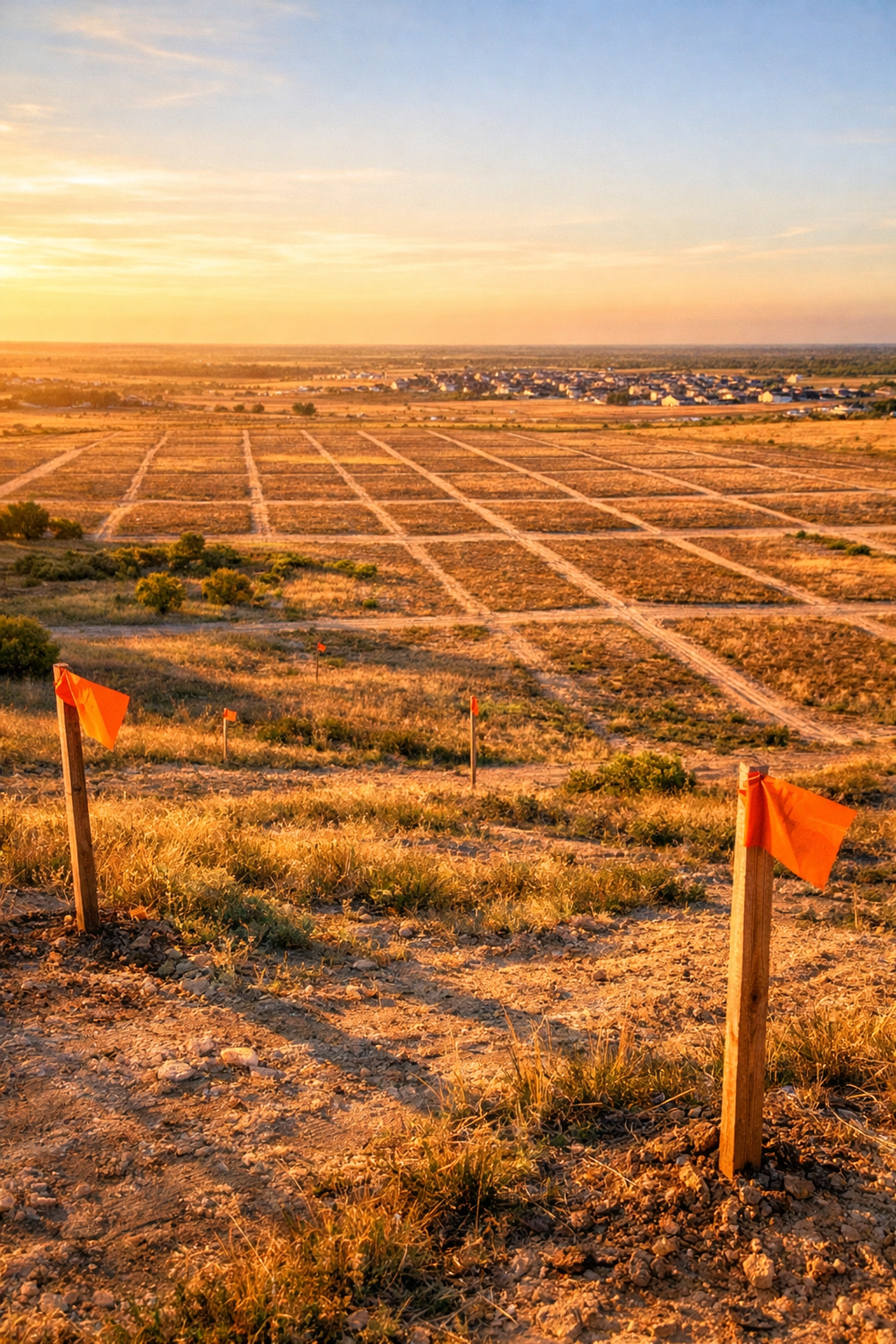
When you buy land as an investment, you're not just betting on appreciation. You're also betting you can afford to hold it until the right buyer, the right development window, or the right zoning change comes along. And the single biggest expense during that holding period? Property taxes.
Let's say you buy a 50-acre tract in Collin County for $2 million. At a typical tax rate of around 2.5%, you're looking at $50,000 per year in taxes. That's $50,000 that doesn't care if the land is making you money, if you're building on it, or if you're just waiting for the market to catch up to your vision.
Over a five-year hold, that's $250,000 in carrying costs before you even factor in loan interest, maintenance, or opportunity cost. If appreciation doesn't outpace that drag, you're underwater: even if the land "value" went up on paper.
Now, with Prop 4's tax compression kicking in, let's say your effective tax rate drops to 2.2%. That same 50-acre tract now costs you $44,000 per year: a $6,000 annual savings, or $30,000 over five years. That's not chump change. That's the difference between a property that pencils and one that doesn't.
Why This Matters More in North Texas Than Anywhere Else
Texas has no state income tax, which is great. But that means local governments rely heavily on property taxes to fund everything from schools to roads to emergency services. As the North Texas region explodes with population growth: DFW added over 170,000 people in 2024 alone: the demand for those services has skyrocketed, and so have property tax bills.
Collin County, Denton County, and the outer ring counties like Kaufman, Rockwall, and Grayson have all seen aggressive appraisal increases over the last decade. Land that was worth $10,000 per acre five years ago is now appraising at $25,000 or more in some corridors, even if it's still dirt with no utilities.

Prop 4 doesn't stop appraisals from going up: your land can still be reassessed at higher values each year. But it does slow the rate at which your tax bill increases by buying down the tax rate itself. That's a crucial distinction.
In a market like ours, where land values are climbing fast but infrastructure and development timelines are slow, the ability to hold land affordably for three, five, or even ten years is what separates successful investors from those who get forced out too early.
The Strategic Shift: Hold Times Just Got Longer
Before Prop 4, a lot of investors were on a tighter clock. High carrying costs meant you needed to flip quickly, get it rezoned quickly, or sell it to a developer quickly. The pressure was always on to monetize the land before the taxes ate up your profits.
Now? The math is different. Lower annual tax bills mean you can afford to be more patient. You can wait for the right buyer. You can hold through a down cycle. You can let the infrastructure catch up to your land instead of selling it before the water and sewer lines arrive.
This is especially relevant in counties like Kaufman and Ellis, where major residential and industrial growth is happening but at a slower, more deliberate pace than the overheated Collin and Denton markets. A few years ago, holding 100 acres in Kaufman County while waiting for a water tap might have been financially unsustainable. Today, it's a viable long-term play.
At Cooper Land Company, we've already seen this shift in how buyers are thinking. Investors are asking different questions now: less "How fast can I flip this?" and more "What's the ten-year outlook for this corridor?" That's a healthier, more strategic approach, and Prop 4 is a big part of what's making it possible.
What This Means for You
If you're sitting on land right now, congrats: your hold just got cheaper. If you're looking to buy, this is a green light to think longer-term. And if you're a developer or builder trying to acquire land, be aware that sellers now have less pressure to move quickly, which could shift negotiation dynamics.
Here's what I'd recommend:
Run your own numbers. Get your current tax bill, apply the new compressed rates (check with your county appraisal district for the latest numbers), and calculate what you'll actually save annually. It adds up faster than you think.
Reassess your hold strategy. If you were planning to sell in the next 12-18 months just to avoid carrying costs, you might want to reconsider. The market could reward patience, especially in growth corridors where infrastructure is coming but not here yet.
Factor this into acquisitions. If you're underwriting a land deal, make sure you're using post-Prop 4 tax assumptions. Using the old tax rates will make deals look worse than they actually are and could cause you to pass on solid opportunities.
The Bigger Picture
Prop 4 isn't just a tax cut: it's a policy signal. Texas is doubling down on being the most business-friendly, property-owner-friendly state in the country. That's attracting more capital, more corporations, and more people to the region, which in turn drives land values higher.
But unlike other high-growth markets where taxes and regulations eventually choke off investment, Texas is actively working to keep the door open. Lower property taxes mean more people can afford to own homes. More businesses can afford to stay and expand. And more investors can afford to hold land until the timing is right.
It's a virtuous cycle, and North Texas is right in the middle of it.
Final Thoughts
The math on holding land in Texas just got better: period. Whether you're sitting on a 10-acre ranchette in Wise County or a 200-acre development tract in Rockwall, Prop 4 is putting money back in your pocket every year. And in a market where timing is everything, the ability to hold longer without bleeding cash is a massive competitive advantage.
At Cooper Land Company, we help investors navigate these shifts and build strategies that actually work in today's market. If you're holding land and want to stress-test your numbers, or if you're looking to acquire and want to understand the true cost of ownership under the new tax structure, let's talk.
The carry cost just dropped. The opportunity window just got wider. Let's make sure you're positioned to take advantage of it.
OUR LISTINGS

© 2026 Cooper Land Company
DMCA Notice | Terms & Services | Privacy Policy | Accessibility Statement
EQUAL HOUSING OPPORTUNITY



Cooper Land Company
2501 Greenspoint Ln, Prosper, TX 75078
Mobile: 214-714-5638
dan@cooperlandcompany.com